
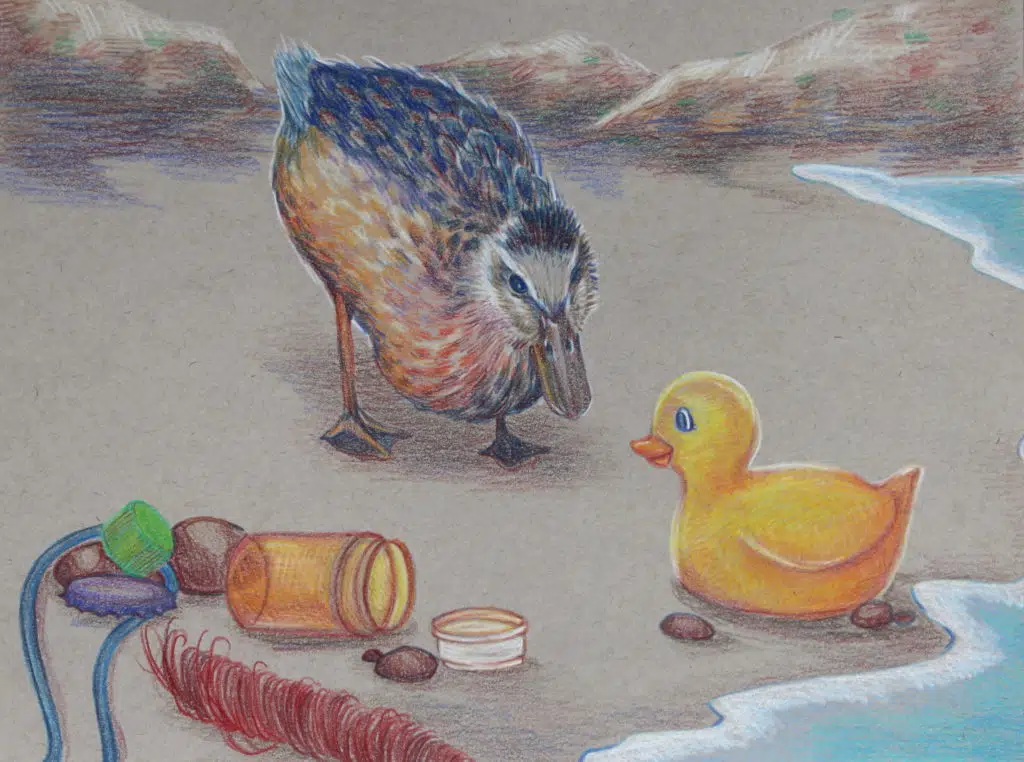

What the Duck
Cupertino, CA
2016, Senior, Art (2014 – 2023)
Works Cited
http://www.bbc.com/future/story/20140722oddobjectsrevealoceansecrets http://www.independent.co.uk/environment/nature/lostatseaonthetrailofmoby duck222678
8.html
http://sanctuaries.noaa.gov/science/conservation/pdfs/lostcontainers.pdf http://www.biologicaldiversity.org/campaigns/ocean_plastics/

Reflection
Reflection
While researching the issue of plastic pollution in Earth’s oceans, I came across one of the most famous cases of cargo lost at sea, the Friendly Floatees. In 1992, about 29,000 of these plastic children’s toys were accidentally dropped into Pacific Ocean. These rubber ducks traveled far across the globe, landing on beaches in Hawaii and Europe. Every year, thousands of shiploads fall into our oceans, polluting the waters and affecting all wildlife that come across these manmade items. They often spend much longer floating in our oceans, as it takes decades or even centuries for some of these plastics to degrade. In fact, up to 40% of ocean surfaces are covered with human trash. In this piece, I want to demonstrate that even a cute children’s toy can become plastic pollution; either way, it ends up collecting either along beaches or in one of six major patches of plastic garbage floating in the oceans, as evidenced by the bottle caps and trash heaps in the back of my drawing. I decided to contrast a live duck with a toy one because it is ironic how the manmade ones may end up harming the real ones. Thousands of marine wildlife are killed annually when they ingest or are tangled in the plastic waste in the water. Just because these cute rubber ducks have been used to trace water currents does not change the fact that like other trash items, they are still part of the plastic pollution problem.