A Beginner’s Guide to Shooting a 360° Documentary as an Indie Filmmaker
February 4, 2026By Alex Mkwizu, 2025 True Blue Fellow
Background: The Artist Behind the Lens
My name is Alex Mkwizu, and I make films about the ocean, but not in the way you might expect. I use 360° cameras to drop viewers directly into the Indian Ocean, where they can stand alongside coral gardeners, fishermen, and the communities fighting to protect their waters. I’m a filmmaker, yes, but also a data strategist and software engineer who believes technology can help us tell more powerful stories about the places we love.
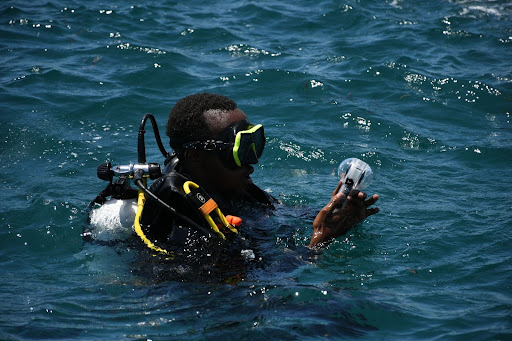
This is how I ended up waist-deep in the Indian Ocean with a 360° camera, trying to capture something that’s almost impossible to put into words: the heartbeat of a reef and the people who depend on it.
The project is supported by the True Blue Fellowship, a global program of Bow Seat: Creative Action for Conservation that grows young ocean storytellers. Through this Fellowship, I’ve been able to embark on a journey that has challenged every boundary of my filmmaking and pushed me into the exciting, complex world of 360° documentary production. I’ve also received year-long mentorship from Future Blue Youth Council members Gavin Tesser and Narayani Shankar.
Setting Context: The “Heroes of the Indian Ocean” Project
Heroes of the Indian Ocean is a 360/XR film mini-documentary series that aims to increase efforts in marine conservation, primarily through the expansion of no-take Marine Protected Areas. By correlating the coral reefs with the ocean’s heartbeat, this series reveals how coastal communities heavily rely on them to survive, how healthy reefs allow the marine ecosystem to prosper, and how this supports the generations and generations of people who have been dependent on fishing and ocean tourism.
My focus was to tell the stories of the Indian Ocean’s hidden heroes, from coral gardeners and local fishers to youth activists and elders.
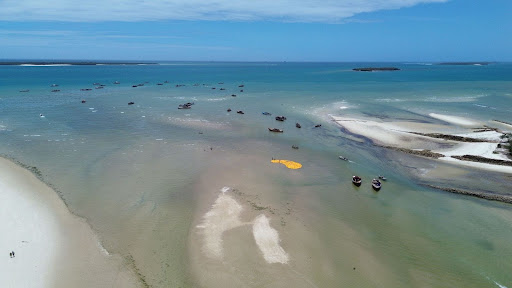
Filming in 360° allowed me to amplify this mission, as I wasn’t merely documenting the ocean’s stories; I was also inviting the audience to experience the world for themselves. Viewers would stand on the coast, feel the salt spray, hear the calls of seabirds, and observe life along Africa’s Swahili Coast.
The Challenge
As an indie filmmaker, I’ve learned that creating a 360° film presents a completely different set of challenges compared to traditional 2D filmmaking. A 360° camera forces you to think spatially, capturing every angle at once and shaping scenes in three dimensions—what’s known as spatial storytelling logic. This means guiding an invisible audience through space while staying invisible yourself, all while balancing creative vision with technical precision. Underwater shooting amplified these challenges: data-heavy, high-quality footage quickly filled memory cards, and with no way to surface mid-dive to swap storage, I often had to make tough real-time decisions about what to delete or keep. The camera frequently overheated underwater, adding even more pressure. All of this happened while managing the physical demands of diving and simultaneously capturing steady, meaningful shots.
The Methodology
When I started filming, I realized that 360° filmmaking is about capturing reality and making viewers feel like they were present in the making.
1. Planning
I spent a lot of time researching and learning about the ocean and its wonders. After that, I went further, consulting marine scientists and scuba divers to gain a deeper understanding. But I didn’t stop there. I spent time with the fishermen and coastal people I would be filming.
I designed something I called a documentary compass guide. A compass guide was like a documentary bible that defined the key messages of the film, including the key characters and their profiles, along with the emotions that I wanted the audience to experience throughout the documentary.
Next, I created a mood board, an inspirational canvas where I was able to combine my initial facts, narrative ideas, and visual elements that would eventually guide the film’s creative direction. Once all of those steps were completed, I was able to develop a script.
The script was accompanied by a storyboard that outlined the key scenes we anticipated capturing. This step was very important to ensure that significant moments didn’t just pass by unnoticed, but were instead curated to enhance the storytelling aspect of the documentary.
2. Tools
With limited funds, I made a deliberate choice to work with lightweight, accessible technology that served the story rather than overshadowed it. The Insta360 X4 was selected not as a compromise, but as a creative tool uniquely suited to immersive, observational filmmaking. Its compact size allowed me to enter environments—both on land and underwater—without disrupting natural behavior, while its 360-degree capture ensured that no moment was lost beyond the frame. In a film that seeks to place the audience inside an experience rather than merely observing it, this capacity to record the full sphere of action was essential.
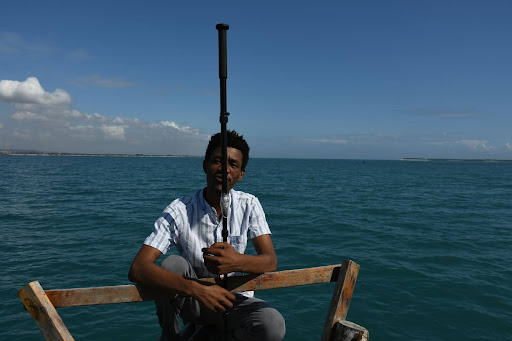
The dive case, invisible stick, and floating stick were practical extensions of this philosophy. The dive case enabled underwater filming in real conditions, preserving authenticity while protecting the equipment. The invisible stick removed the presence of the filmmaker from the visual field, creating the illusion that the viewer is floating freely within the scene—an approach that echoes the quiet, unobtrusive traditions of observational documentary. The floating stick ensured stability and safety during aquatic sequences, allowing sustained shots that feel calm, deliberate, and immersive rather than hurried or technical.
Post-production relied entirely on free or widely available tools—Insta360 Studio for stitching, and Adobe Premiere Pro with the Insta360 reframe plugin for editing, grading, and spatial sound integration. This workflow demonstrates that high production value in 360 filmmaking is not dependent on expensive proprietary pipelines, but on thoughtful planning and disciplined storytelling. The technology was chosen to disappear behind the narrative, reinforcing the central idea that compelling documentary cinema is driven not by budget or gear, but by clarity of vision, a strong cause, and respect for the world being filmed.
3. Production & Post-Production
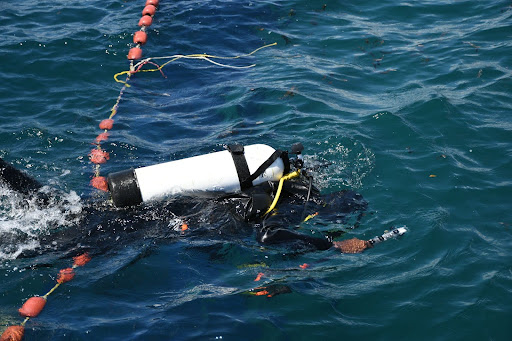
Underwater, 360° filmmaking feels almost poetic, with the ocean acting as both canvas and collaborator. Using the Insta360 X4, I placed the camera at the center of each scene, allowing life to unfold naturally in every direction. Light refracted through the water column, wrapping coral, sand, and drifting particles in soft, shifting patterns, while the natural hum of the ocean established a calm, unforced rhythm. The small, unobtrusive camera allowed marine life to behave organically, turning even subtle movements into meaningful moments within a fully immersive sphere.
In post-production, Insta360 Studio and Adobe Premiere Pro became tools for shaping attention rather than controlling the frame. Stitching and stabilization preserved a floating, observational perspective, while gentle reframing, color grading, and spatial audio in Premiere guided the viewer’s awareness without breaking immersion. Rather than fast cuts, the edit relied on flow—movement, light, and sound gently leading the eye across the spherical image.
A carefully curated voice-over script became the spine of the film. In a 360° environment, where the viewer is free to look anywhere, the voice-over provides narrative gravity—connecting images to meaning, science to emotion, and moments to a larger cause. When delivered with restraint and intention, it does not explain the ocean; it invites the audience to listen to it. This balance between immersive visuals and thoughtful narration transforms simple, affordable tools into a powerful cinematic experience driven by story rather than scale.
Hope & The Way Forward
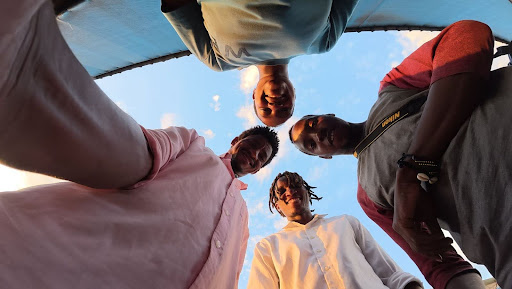
“Heroes of the Indian Ocean” is only the beginning. I believe this project represents a model for young indie filmmakers, especially those from coastal nations, to document their own realities without waiting for permission or for perfection.
To replicate such a production:
- Start with one powerful story that is also personally meaningful to both you and your community. A project often succeeds better if it is of direct relevance. And remember that the ocean is vast, but even one voice can have a large impact.
- Leverage small tools: Today’s compact 360° cameras are powerful enough for creating a full documentary.
- Local collaboration: The community is both your subject and your crew.
- Learn by doing. Using new equipment can be challenging, but each mistake at sea teaches you more than any online tutorial ever could.
So, with all of this information, I want to make a call to action to every young aspiring filmmaker and ocean lover: Although the oceans are changing faster due to climate change than our cameras can capture, your camera can still encourage the world to take action for our oceans.
About the Author:
Alex Mkwizu is a multidisciplinary artist with over three years of experience, passionate about experimenting with different mediums and leveraging digital technologies. His work focuses on new media, particularly AI (Artificial Intelligence) and XR (Extended Reality), to enhance human storytelling capabilities.
Alex has contributed to several award-winning creative projects, including a C-Section VR Training Simulation, the first of its kind across 42 African countries that competed in the Meta AR/VR Africa Metathon curated by IMISI3D. He was recognized as an award-winning young photographer by Invision Africa, with his work exhibited at Michigan State University. He also received recognition as an AI Generative Artist, winning a competition curated by Shutterstock and AI4Good, with his work exhibited in Geneva.
Through the True Blue Fellowship, Alex is producing an XR film documentary addressing the coral reef crisis and highlighting Marine Protected Areas along the Indian Ocean. Most recently, he was awarded Best VR Project at Creation Africa 2025 (Lagos Edition). And has also been selected to produce a VR Experience about AI Singularity by MSU (Michigan State University ) Museum Labs.
In addition to that, Alex has curated several TEDx events, including TEDxUniversityOfDarEsSalaam and TEDxZanzibar, amplifying local narratives to global audiences.