Coming Out of My Shell
February 24, 2026By Coji Senanayake, 2026 Future Blue Youth Council member
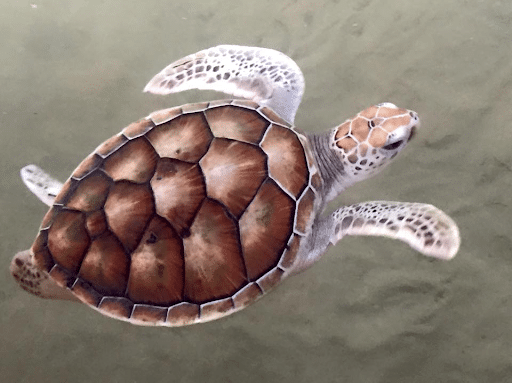
I met Leatherback, Loggerhead, Olive Ridley, and Hawksbill a while back. Are they the cool kids in school? No. Are they part of a rock band? In the traditional sense, still, no. Let me cut to the chase – they happen to be the different species of sea turtles, who, along with Green Turtles, have made the waters of Sri Lanka their home.
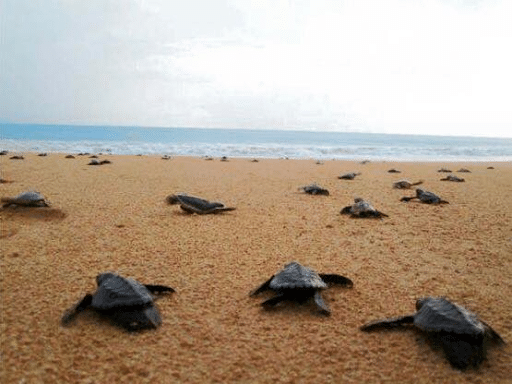
I met them when I was around 7 while visiting a turtle hatchery in Kosgoda. We waited until the world turned dark, and under a watchful moon, we released these baby turtles onto the nearby beach and watched them scuttle to the sea. This was a way to protect these eggs from predators and poachers, and for now, these turtles were safe. This was important, since the Olive Ridley turtles and the Leatherbacks are now considered vulnerable species; the Loggerheads are classified as endangered, while the Hawksbill turtles have appeared on the International Union for Conservation of Nature (IUCN)’s Red List as a critically endangered species.
Since Sri Lanka is a small island nation, the beaches and seas are an integral part of most people’s lives. So, one day, two years from then, while walking on the beach, I came across another turtle who had met an untimely end after suffocating on a plastic bag, and that affected me on a profound level. But empathy, as important as it is, cannot stand alone. So, I decided to do something about this. It was then that I found out that people generate over 400 million tons of plastic waste worldwide, and that Sri Lanka disposes of 1.5 million tons of plastic each year, much of which ends up in the ocean. Also, research published in the Marine Pollution Bulletin found that 87% of sea turtles in Sri Lanka consume waste products, underscoring the problem’s monumental proportions.
So, from then on, I started doing small day-to-day actions to help the planet. For instance, I started avoiding single-use plastic in most of its forms, whether in water bottles, cutlery, or polythene bags. I then realized that there are suitable alternatives to disposable plastics made from more sustainable materials, and that planning ahead can make me avoid plastic products to a large extent.
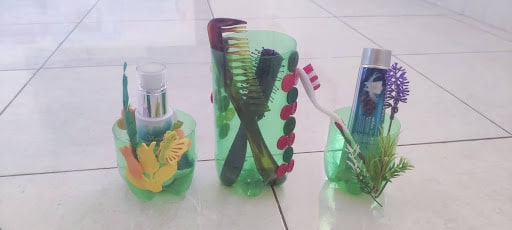
I also started making colorful utility holders from discarded plastic bottles, which I collect on beach clean-ups or when I pick up litter from my street.
Still feeling that I need to do more to protect the marine eco-system from discarded plastic, I turned to building awareness on such matters and wrote a book for small children, titled “Myrtle, Burble, and the Green Thing,” which speaks of the harms of plastic to marine life by way of a story about two young turtles and their encounter with a plastic bag, but it is a tale that fortunately ends happily.
These are the first few chapters of my story, but stay tuned for more to come.