Let Interviews Lead: Environmental Injustice Through Film
January 26, 2026By Jina Song, 2025 Future Blue Youth Council member
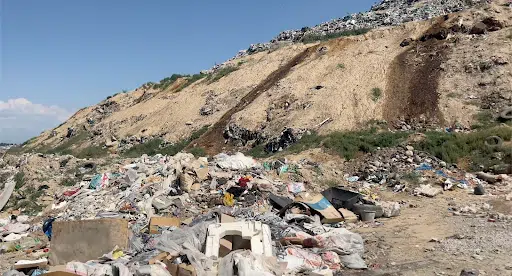
Cover image: the waste mountain of Altyn-Kazyk
Can documentary art become live advocacy?
Interviews plunge you into realities you’ve never imagined. Each conversation pulls you closer to lived truth, dismantling answers you thought you already had. My own questions began to trail behind their stories: How did you realize pollution was the issue? What helped the children here survive? Film enables you to tie each revelation together. Interviews turn climate change from data points to people you can’t unsee.
Film as Artivism
It might not involve drawing or sculpting, but film is art—and a loud one. When moving images, sound, and real voices collide, facts stop feeling distant. Artivism harnesses this strength. A 2023 honors thesis on climate visual media found that environmental trailers triggered strong emotional responses and were seen as effective at showing the science of climate change. According to DeVore, films possess unparalleled lasting impacts on the audience, thanks to their dynamic, multisensory nature. In an increasingly globalized landscape, the path to bringing it to the global stage is clearer than ever. In Bow Seat’s own Contest Gallery, you can see hundreds of films from dozens of countries.
A Lesson from a Golden Stake
While visiting family this summer, I traveled to a Kyrgyz community called Altyn-Kazyk—it’s a community of over 16,000 individuals. Families here bear the human cost of waste and pollution beneath a mountain of urban waste. It is where most residents make their living by sorting through trash.
As our volunteer team walked through the town, I panned through crumbling buildings and roofless homes. It seemed like a place of utter desolation. A literal peak of climate injustice. Yet, as interviewees began their stories, I realized I was wrong. The houses were not crumbling, but were built—literally brick by brick as they purchased one from a nearby store with each monthly salary. The children, their clothes hanging loose, hair clouded by dusty air, lit up as bright as any child would.
They shared stories of resilience, hope, and strength in this wasteland. Each story unfolded another angle of this mountain. Tajik, a grandmother of five, recounts waking at 5 a.m. to begin sorting through the waste. The shot shifts to crows circling a mountain of waste. Juldush, a man who has lost his arm, explained how he moves the trash with his wife, day after day, for a living. Togunine, a thirteen-year-old girl, has hopes to leave this place and become a pop dancer.
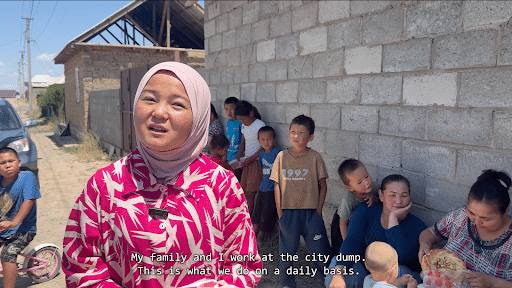 Interview with Togunine, Altyn-Kazyk resident
Capturing this all through my phone, I realized how advocacy can happen anywhere. Our phones are often magnetically attached to us—but what if we used those screens to hold messages that drive environmental action? Looking around you and talking to those who bear the brunt of the weight of this can get others to care, too. This pause mattered. And it mattered even more as the residents revealed what Altyn-Kazyk meant.
In Kyrgyz, Altyn-Kazyk (Алтын-Казык) means “Golden Stake”—a term for the North Star. It is the guiding point for nomadic people to navigate each night. They were not passive victims, but practiced navigators who knew how to move forward even in the dark. Without sitting down to listen, I would have told the wrong story. As of this winter, my film, “Altyn-Kazyk: The Golden Stake,” was featured on the ConnectHER gallery (Viewers are able to support the film through the platform here). For me, the documentary wasn’t a result, but a point of clarity. More importantly, it affirmed that listening can be the first step toward action.
The question that followed for me was simple: how do you begin responsibly? For me, that meant turning reflection into practice.
A Quick Starting Point
The ideation phase includes creating outlines for a timeline, storylines, organizing interviews, b-roll, and more. Personally, I refrain from making a storyline too rigid. After researching the central topic, I drafted and translated general interview questions to ask, just a couple, based on each section of the story arc. From there, the interviews take on a direction of their own; your job is to painstakingly prune and mold that truth into a narrative. After hearing my interview’s content, my last documentary took a last-minute swerve—yet still landed the Best Documentary runner-up for the ConnectHER film festival.
1. Interview Angles to Frame Voices
Think of interview angles as designing the frame of your artwork. What perspective do you want to portray your film through? Some ideas include high angle to highlight vulnerability, eye-level for direct connections, and a worm’s eye view to emphasize dominance (Edwards).
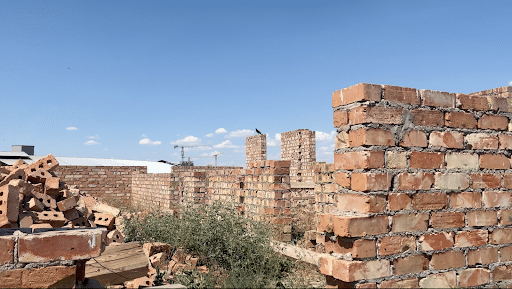 A house in progress, brick by brick
2. B-Rolls as Meaning
Texture-focused shots can be used to illuminate a unique setting or symbolic object in your film. For instance, I love architectural close-ups for poignant details.
3. Sonic landscape
This element entails instrumental music, sound effects, and even targeted moments of silence. Especially those featuring the culture you are portraying can ramp up or shift the emotional weight of any documentary (“In the Mix”). Sound is what makes a message resonate and “stick.”
4. Sustainable Shooting
But have you imagined your phone could turn into one of the most powerful tools for environmental advocacy? Well, it’s fully possible to shoot an award-winning film with just a phone and a hand-held tripod. Just toggle a couple of settings with guides like this one to transform your phone into a 4K camera. The film was shot entirely on my phone—yet it would later screen across three continents. Standing there, it became clear that interviews, not lens size, are what give stories their power.
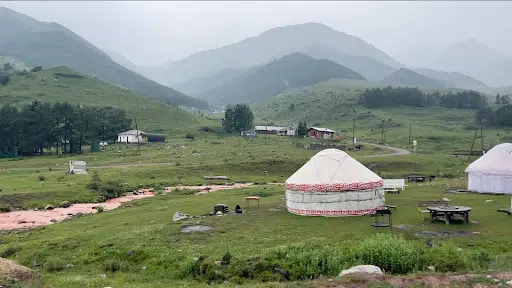 Nomadic community in Kyrgyzstan
What the Camera Missed at First
This documentary project became the foundation for a youth-led climate education initiative in Altyn-Kazyk. Through ProjectPolaris, local youth now design curriculum and community learning grounded in their own data, language, and lived experience in collaboration with other local NGOs like FHI. I used to think advocacy began with knowledge. Now, I realize it begins with a willingness to unlearn. My mistake was assuming I understood the story before I understood the people. Interviews don’t cherry-pick information; they change the storyteller. If you’re going to film your community, start there. Listen honestly. The best story is one that’s lived, not on a storyboard.
All photos from “Altyn-Kazyk: The Golden Stake” (2025)
Works Cited
DeVore, Erik. Lights, Camera, Climate Action: Investigating Emotional Responses to Climate Change Trailers (Documentary, Television, & Narrative Film). Portland State University Library, https://doi.org/10.15760/honors.1399. Accessed 20 Dec. 2025.
Edwards, Josh. “The Ultimate Guide to Perfect Interview Shooting – Artlist Blog.” Artlist Blog, 12 Dec. 2024, artlist.io/blog/interview-shooting/. Accessed 20 Dec. 2025.
“In the Mix: A Practical Guide to Navigating the Post-Production Audio Process.” International Documentary Association, 24 July 2024, www.documentary.org/feature/mix-practical-guide-navigating-post-production-audio-process. Accessed 20 Dec. 2025.
von Wallström, Johnny. “Documentary Filmmaking: Where Authenticity Meets Grit.” Medium, 30 Jan. 2024, medium.com/@jonnyvonwallstrm/documentary-filmmaking-where-authenticity-meets-grit-1d011e7984b2. Accessed 20 Dec. 2025.
Ormsby, Richard. “Sustainable Filmmaking: Go Green and Save Green – Media Services.” Media Services, 15 Aug. 2024, www.mediaservices.com/blog/sustainable-filmmaking-go-green-and-save-green/. Accessed 20 Dec. 2025.