Why Environmental Defenders Need Defending
September 19, 2023By Dhruv Bhatt, 2023 Future Blue Youth Council member
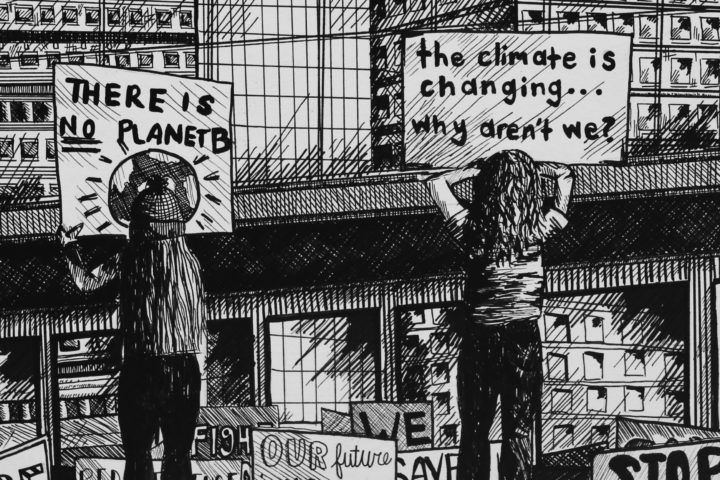
Featured Image: “Climate Strike” by Anna Thompson (Illinois, USA)
On January 15, 2021, 11-year-old environmental rights activist Francisco Vera received a death threat from an anonymous Twitter account. His crime? Leading an environmental group in Colombia and lobbying his government to improve connectivity for children studying online.
Environmental rights are an extension of fundamental human rights, such as the right to education and non-discrimination. Every person has the right to clean surroundings, sanitation, and native lands. Over 100 countries guarantee their citizens a constitutional right to a healthy environment. Similarly, everyone has the right to oppose decisions that harm the environment or aggravate climate injustices.
UN Environment defines Environmental Human Rights Defenders (EHRDs) as persons exercising, promoting, and defending environmental rights. These heroes play a pivotal role in our collective battle against ecological degradation on every front. It is through their tireless work that we can strive towards a world that is both healthy and just, ensuring safety for all.
Yet, on average, four defenders have been killed every week since December 2015 – the month the Paris Climate Agreement was signed when the world came together amid hopes of a new era of climate progress. Violent attacks, arrests, death threats, sexual violence and lawsuits continue to silence many others.
Many of them, predominantly indigenous activists and women, engage in their activities from sheer necessity. Many do not even consider themselves environmental rights defenders and are unaware of protective measures, resources, and remedies available to rights-based activists. This lack of awareness about the rights of a human rights defender means that vulnerable activists cannot seek help from international organisations, and these organisations, in turn, are unaware of their plights and needs.
For women, the fight for their environmental rights is even more difficult. As poignantly noted in this brief on environmental and women’s rights, climate change is not just about levels of greenhouse gases but often, first of all, about the bodies, lives, and livelihoods of women, girls, and trans and intersex people and their communities across the world. Gender minorities worldwide face increased sexual and physical violence, higher direct dependence but limited control over land and water resources, and gender disparities in accessing essential social services such as health and education. The deep interrelation between gender and environmental justice results from an economic system that treats and exploits women and nature as disposable.
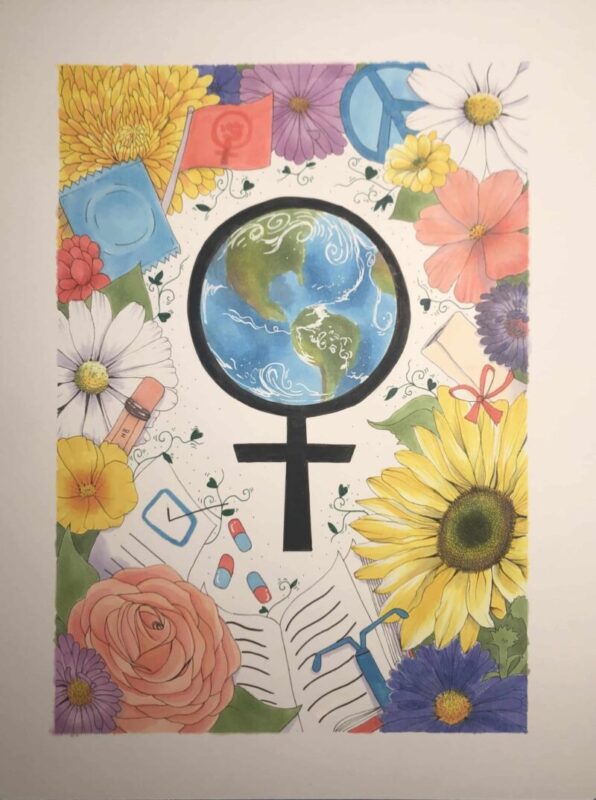
“Help Women Help the Earth” by Taina Cunion (Virginia, USA)
Evidence shows that a more significant presence of women in community decision-making bodies leads to better protection of common property resources. Yet, as recently as 2018, less than 1% of all international philanthropic funding went to women’s environmental action.
These underfunded women activists are traditionally required to look after children and older people in their families while also earning a living and continuing their rights-based work. Even then, women who speak out against injustices by influential stakeholders like governments and corporations are vulnerable to gender-based violence, including sexual assault.
For instance, Cressida Kuala of Papua New Guinea, the founder of the Porgera Red Wara (River) Women’s Association, regularly receives threats and has suffered repeated sexual assault for helping and advocating for indigenous women and girls displaced by mining operations or sexually abused by mining company employees. Despite these challenges, she continues her campaigns for women’s right to security and a healthy environment and to be fully involved in decisions that affect their lives.
As a generation born in the face of poly-crisis, many youth and children also feel abandoned, betrayed, and excluded by key leaders. Just like Francisco, we are vulnerable to attacks and repercussions for our environmental campaigns. In countries like the Philippines, even schools that teach children about their culture and the ecology of their land are coming under attack! In 2019, the Filipino Department of Education ordered the closure of Salugpongan schools, alleging that many failed to comply with government regulations and had links with rebels. This move primarily affected the Talaingod-Manobo communities that unified decades earlier to protect their native Pantaron Mountain Range.
For native and indigenous groups, the fight for environmental rights is the fight for the sustenance of their culture and future. Between 2015 and 2019, over a third of all fatal attacks targeted indigenous people – even though indigenous communities comprise only 5% of the world’s population. In an interview, indigenous activist Tomez Gomez, the leader of the rights group COPINH in Honduras, said: “The hitmen tell people, ‘I’m going to kill this and that person.’ They have lists telling them to kill 20 people, and there’s a price on our heads. For me, it’s 200 dollars.”
Not shockingly, countries with diverse and numerous indigenous groups, like Colombia, Honduras, India, and the Philippines, also account for a large percentage of attacks and deaths of environmental activists. In the worst cases, as in Colombia, several indigenous cultures are at risk of extinction, prompting many organisations to denounce these attacks as genocide against the indigenous communities.
With our schools closed, rights infringed, and communities disrupted, where do we go? Fortunately, all hope is not lost. Widespread campaigns by Environmental Human Rights Defenders are bringing about change. In August 2023, Ecuadorian indigenous and women-led activism efforts led to a historic referendum that will halt the development of all new oil wells in the Yasuní National Park in the Amazon, one of the most biodiverse regions on the planet.
Earlier this month, General Comment 26 was released. It is authoritative guidance by the UN on how children’s rights are impacted by the environmental crisis and what governments must do to uphold these rights to ensure that children live in a clean, healthy and sustainable world. What makes this General Comment even more remarkable is that it is an outcome of collaboration with over 16,000 children from across 121 countries, including children residing in communities at the forefront of the environmental crisis.
“People don’t get all of the connections [when] they say the environmental group(?) is over there, the civil rights group is over there, the women’s group is over there… Actually, all of them are one group, and the issues we fight become null and void if we have no clean water to drink, no clean air to breathe, and nothing to eat.” –ACTIVIST CORA TUCKER
All people have a stake in supporting these environmental heroes and protecting their rights as they advocate for ours. We must amplify the voices of vulnerable groups fighting for our collective rights: women, children, natives, and youth. Learning and sharing their stories and connecting them to our lives in meaningful ways is a great way to honour their work, show solidarity, and spearhead grassroots initiatives. After all, everyone can be an ally!
As our heroes brave grave threats to their lives and dignity, devastating floods continue to ravage cities. Year-long droughts give us a glimpse of the consequences of inaction. Stars lie silenced behind haze and smog. The moon grows even more distant. Yet the light of our heroes reaches us.
Ever so faint.
Ever so weak.
But the light reaches us.