
Living on the EDGE
October 6, 2026By Coji Senanayake, 2026 Future Blue Youth Council member
The EDGE (Evolutionary Distinct and Globally Endangered) List is definitely not a good place to be. Yet, I found that 968 different types of ray-finned fish and 156 species of sharks and rays from all over the world have made it to the EDGE of Extinction List for 2024.
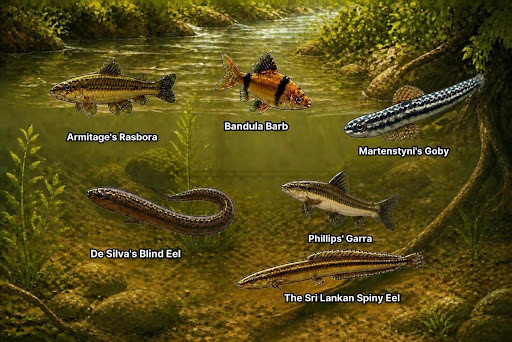
I then decided to look more closely at this index with a local focus. I discovered that 20 ray-finned fish from Sri Lanka have indeed made it to the list, with some classified as vulnerable, others as endangered, and yet others as critically endangered. Of these, the Top 6 that have made it to the critically endangered list from Sri Lanka are:
- The Sri Lankan Spiny Eel
- De Silva’s Blind Eel
- Phillips’ Garra
- Bandula Barb
- Martenstyni’s Goby
- Armitagei’s Rasbora
Interestingly, I found that the Bandula Barb—which is a global rarity—cannot even be found all over Sri Lanka. Instead, it is confined to a single, tiny 3-kilometer (1.8-mile) stretch of stream in the Kegalle District.
Because endemic species exist in only one specific geographic location, localized environmental degradation can wipe out their entire global population. To me, the extinction of an endemic species means a permanent loss of genetic heritage that cannot be replaced or repopulated from anywhere else. It also leads to a domino effect—disrupting the aquatic food web and destabilizing the entire ecosystem.
To protect these freshwater fish, I believe we have to mitigate pollution, regulate the runoff from agricultural pesticides and synthetic fertilizers, and minimize the impact of mining on these waterways. We should also ensure that their habitats are preserved and that poaching is strictly prohibited. Finally, with government backing and the advice of environmental professionals, we can carry out the translocation of a few animals to breed them safely in controlled facilities.
However, saving these species isn’t just a job for a specialized group. It requires all of us to care about what happens to our local waterways. By speaking up for habitat protection and supporting local conservation efforts, we can ensure that these animals don’t disappear on our watch.