
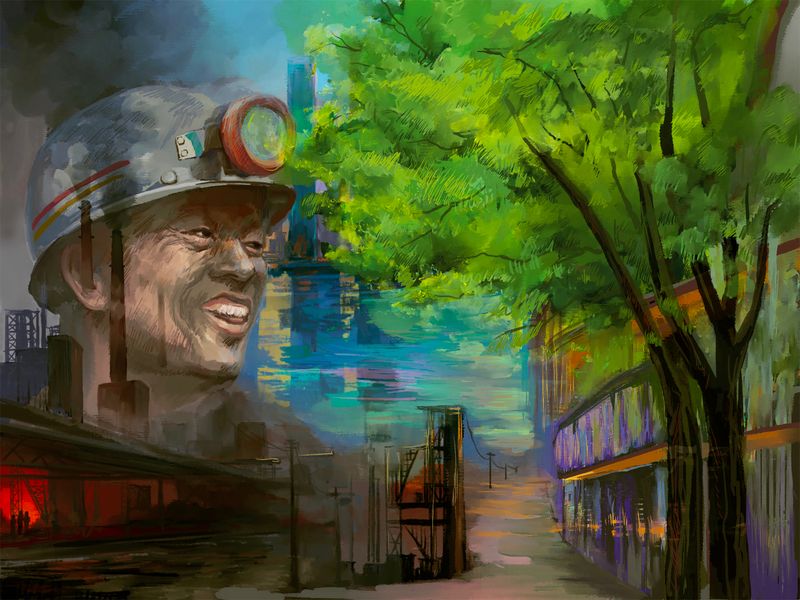
In Between Concrete and Green
Wallingford, CT
2025, Senior, Art: Digital (2024 – )
Reflection
Growing up in Shanxi, one of China’s most coal-dependent provinces, my connection to nature has always been filtered through smog and steel. This painting is both a recognition and a challenge. It’s a recognition of the generations of coal miners who devoted their lives to building the industry. It’s also a challenge to reimagine what environmental justice means in a transitioning society. We are living in a pivotal era, where nations are shifting from fossil fuel dependency to green technologies and low-carbon economies. Yet in this “transition,” who gets left behind? In Shanxi, the story of climate action is not only about phasing out coal. It is about the lives of workers and families whose health and futures have been sacrificed for economic progress. While the government applauds emissions cuts, the people who powered that progress still breathe in its residues, both physical and emotional. The background of this painting is inspired by my hometown’s landscape—industrial and monochrome, built in modular forms to serve the needs of production, not people. Aging infrastructure, poor environmental planning, and a lack of human-centered design have left many residents, especially former industrial workers, trapped in a concrete jungle. They face not only environmental pollution, but also emotional isolation, economic insecurity, and spatial marginalization. Yet on the right side of the painting, I offer a vision of renewal. Sunlight filters through lush tree canopies. It is a landscape reimagined with sustainability, where forests replace smokestacks, and where urban design fosters environmental regeneration and human flourishing. Environmental justice is not only about protecting forests and oceans. It is about restoring the broken relationship between people, place, and the planet. That begins by asking: How do we honor the sacrifices of the past while building an inclusive, livable, and green future for all?