
The Wasteland of Technology: Ecological Revelations of a Tech Tree
Shenzhen, China
2025, Junior, Art: Handcrafted (2024 – )

Reflection
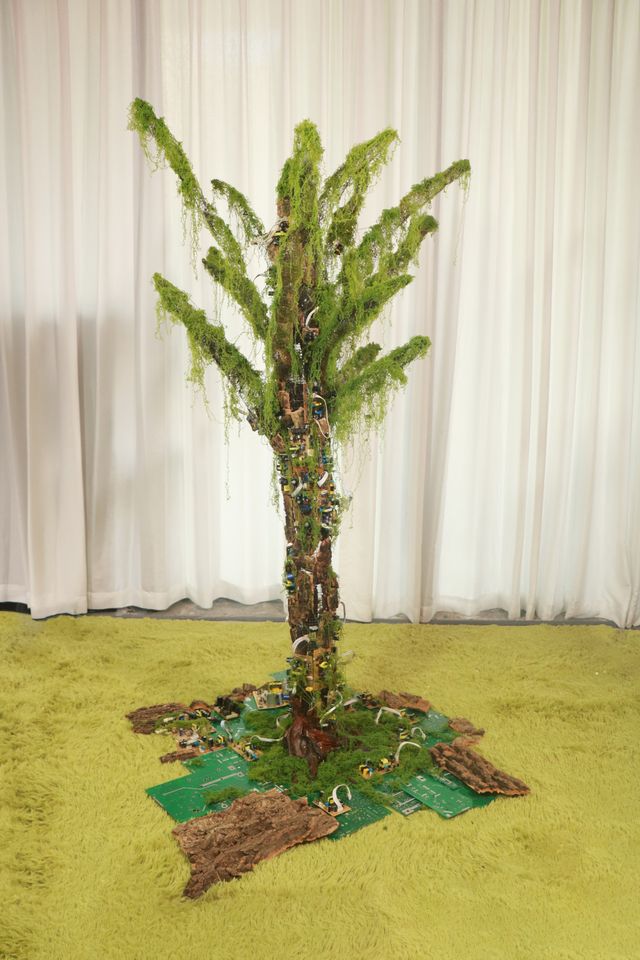
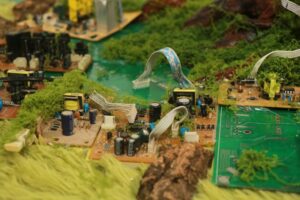
In an age rebuilt by concrete and technology, humanity faces an ecological paradox: we use smartphones to track air quality while creating waste that poisons the soil; we develop clean energy while destroying mountains for lithium. Electronic Wasteland is a 3.5-meter installation that turns this contradiction into a fable. Its “technology tree” is made of stacked discarded circuit boards—tree rings of our digital era—wrapped in salvaged wutong bark marked with wormholes and chisel scars. The materials expose a stark timeline: bark decomposes in 3–5 years, metal mesh in 50, but heavy metals in electronics take over 1,000 years. This raises a sharp question: if our products outlive nature itself, is our “circular economy” only delaying ecological debt? The base is a “technological soil” built from recycled hard drives, projecting real-time global deforestation data. Stepping on certain areas triggers crisis imagery: Amazon fires, palm oil expansion, melting permafrost. Above, the technology tree looms, creating a harsh dialogue between nature’s collapse and our inventions. Yet at the seams of the circuit boards, real plants—moss and succulents—begin to grow, a quiet rebellion showing nature’s persistence even in artificial ruins. The work becomes an ecological portrait of our era: roots of tangled cables, leaves of shattered silicon, and a trunk holding traces of real life. When touched, it emits both birdsong and electronic noise, echoing our split existence. As this “tree” rises, we must ask: in building our technological world, are we cutting off the very branch we depend on?