Environmental ARTivism: How Austin Picinich Fights for Salmon—and his Tips How You Can Lead Your Own Mural Too
January 16, 2026By Gavin Tesser, Stella Hong, and Narayani Shankar, 2025 Future Blue Youth Council members
Did you know that in Seattle, environmental activism can look like art? Austin Picinich’s project, Save Our Salmon, is raising awareness about salmon conservation through murals and community paint days. Read more about Austin’s project and how you can get involved in ARTivism below!
How Save Our Salmon Began
Although he had grown up only minutes from Juanita Creek, a stream in Kirkland, Washington, artist Austin Picinich did not realize that there were salmon in his backyard until he was in eleventh grade. He had passed by Juanita Creek every day to reach his school, yet never paid much attention. Hidden beneath culverts and paved roads, the stream was barely noticeable. However, after Austin learned that only three salmon had returned to spawn that year, he was determined to use his artistic skills to shine the spotlight on these hidden streams.
Throughout Washington State, there are over 800 streams. Most streams are small, but they teem with life, providing shelter, breeding grounds, and feeding areas for salmon, which are critical keystone species. However, before the streams can make it to their final destination, the Pacific Ocean, they must pass through numerous cities and urban towns. In these developed areas, roads, buildings, and systems of pipes hide these streams from the public eye. Thus, many Washington residents grow up disconnected from the aquatic environment around them. So when Austin discovered that the salmon population in Juanita Creek was in critical danger, he realized he could use his talents in art to transform the dull buildings near the Creek into vibrant murals of salmon, and Save Our Salmon was created.
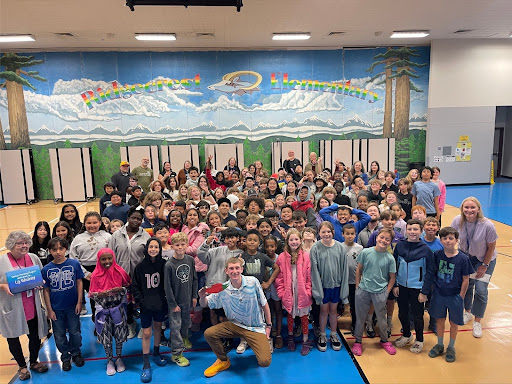
In April 2022, Austin held his first “community paint day” to start working on his mural for Juanita Creek. Over 160 volunteers showed up to help paint Austin’s design onto the wall, resulting in a vibrant mural depicting salmon swimming through colorful waters. The previously hidden stream quickly became a focal point in the community.
Save Our Salmon Project Journey as a True Blue Fellow
The project is supported by the True Blue Fellowship, a global program of Bow Seat: Creative Action for Conservation that supports youth-led environmental projects.
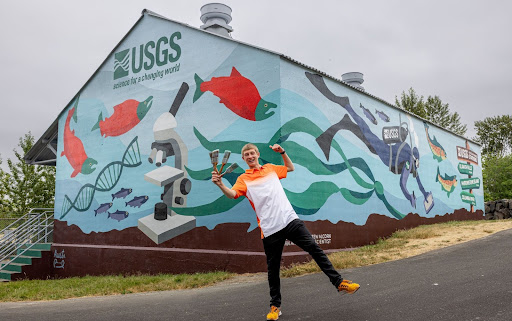
Since its start in 2022, Save Our Salmon has been able to expand rapidly. Over 700 painters and youth from Austin’s local community participated in the mural volunteer events. Initially, many of them had started with a focus on art, but their participation in this project led to an increased interest in environmental activism, with many of the volunteers returning for future paint days. The previously small and local project to raise awareness of salmon in local streams has now evolved into an artistic effort involving the entire community, even receiving attention from news organizations such as FOX 13 and The Seattle Times. Currently, as we reach the start of 2026, Save Our Salmon has painted over 3,000 square feet of walls with vibrant salmon murals. Three murals now stand across the three sites of Kirkland, Lake Forest Park, and Magnuson Park, with each one selected to bring attention to the streams nearby. Additionally, approximately $23,000 was raised through fundraisers and distributed back into salmon conservation efforts.
Throughout this year, the project has also received support from three Future Blue Youth Council members: Stella Hong, Gavin Tesser, and Narayani Shankar. The FBYC members would meet monthly with Austin to discuss updates and focus on expanding the project’s reach. As Austin decided to create a simple and easily replicable toolkit for other communities to implement mural projects themselves, we were able to provide important feedback and brainstorm ideas for how the toolkit would be most effective. This perspective was particularly valuable because the toolkit’s audience included high school students, such as ourselves, providing us a unique lens through which the toolkit could be examined. In fact, currently, Save Our Salmon is in the process of expanding from Seattle to other schools.
How to Lead a Successful Community Mural Project: Tip List from Save Our Salmon
Want to start a similar project in your community? Here’s what Austin learned from painting 3,000 square feet of murals and mobilizing 700+ volunteers:
1. Go Micro to Make a Macro Impact: While the ultimate goal might be “save the ocean,” Austin focused on salmon in specific creeks in specific neighborhoods. The Juanita Creek mural wasn’t about salmon in general – it was about the three salmon that returned to spawn in a creek most neighbors walked past daily without noticing. Before going nationwide, start in your neighborhood. Identify an endangered, threatened, keystone, or flagship species that lives in your area but lacks visibility. Maybe your community doesn’t have salmon, but you’ve got native bees, watershed-dependent amphibians, or migratory birds. Every neighborhood has species that need protecting.
2. You Don’t Need to Be an Expert—You Need the Right Partners: Austin had never created a mural before launching Save Our Salmon. “I was just a high schooler who liked art,” Austin described. But his superpower? Connecting with the right partners who had what he lacked. Austin reached out to Urban Artworks, a local arts nonprofit, for arts equipment and technical support – prepping the wall, borrowing tarps, ladders, and brushes. He partnered with the University of Washington’s Salmon Watchers program for conservation expertise and connected with a biology professor who developed educational curriculum about salmon. When approaching potential partners, prepare a specific ask and a clear value exchange of what you’ll offer in the partnership. Identify which skills or resources you need, and look for environmental nonprofits, university departments, or conservation initiatives whose mission aligns with yours. It can all begin by simply searching “local environmental organizations” in your area.
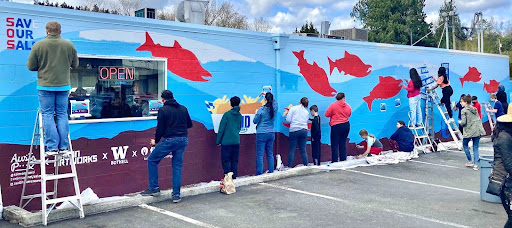
3. Make it “Our” Mural (not “My” Mural): Save Our Salmon projects are truly community-led. As Austin says, each mural is “not just painted by me as the artist, but co-created by the whole community.” By making murals true community efforts, Austin was able to multiply the project’s impact by 10x versus if he had painted these murals on his own. Involve community members in planning, fundraising, and organizing alongside painting to make the project bigger than a single artist. This means involving people beyond the paint day. Community members helped with fundraising, organized logistics, spread the word, and shaped where the project went next. When people have ownership, they become advocates – not just participants. Host planning meetings where community members vote on design elements or locations. The more hands involved in building it, the more people will protect and promote it afterward. The environment is ours to share. Austin says, “it’s not my creek, it’s our environment to take care of,” and co-creating the murals builds this community of stewards.
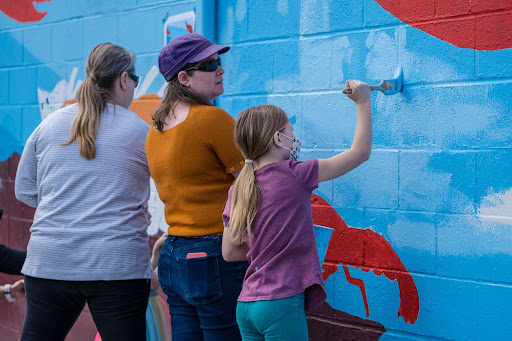
4. The Easier It Looks, the More People Show Up: One of the biggest attributes of the Save Our Salmon project is its paint-by-numbers approach, which allows anyone of all ages to confidently contribute. Austin emphasizes that “success stems from simplifying.” Break complex designs into labeled sections, pre-mix colors, and give instructions. This speeds up the process and allows neighbors to join. Remove the intimidation factor so people think “I can do this” instead of “I’ll mess it up.” If you want 200 volunteers instead of 20, think simple.
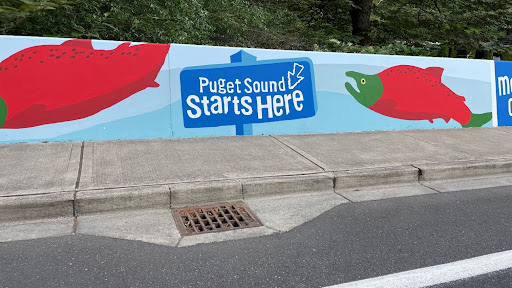
5. Place the Art Where the Problem Lives: A mural’s impact depends on who sees it and how often. So, it is preferable to select a high-visibility spot. In other words, be intentional with the location you choose. Austin often chooses locations where the story of the mural is revealed in a surprising or meaningful way. For example, he painted a salmon mural on a bridge over a creek, and most community members never knew salmon lived in that creek until the mural drew attention to it. Also, when finding a location for a mural, try to choose prominent places, including parks, schools, bridges, or community centers that are visible to the public.
Your Turn to Take Action
Austin’s initiative began with a realization that salmon were swimming around his neighborhood, unknown to residents. Years later, Save Our Salmon has painted over 3,000 square feet of murals, raised over $23,000 for conservation efforts, and has engaged more than 700 volunteers.
Ready to start or take your own project to the next level?
The True Blue Fellowship, sponsored by Bow Seat: Creative Action for Conservation, provides funding, mentorship, and resources to help youth launch global environmental projects with up to $2,500 in funding. Apply at Bow Seat’s True Blue Fellowship.