
Nature’s Latest Masterpieces: The Unbelievable Life Found This Year
March 12, 2026By Emaan Danish Khan, 2026 Future Blue Youth Council member
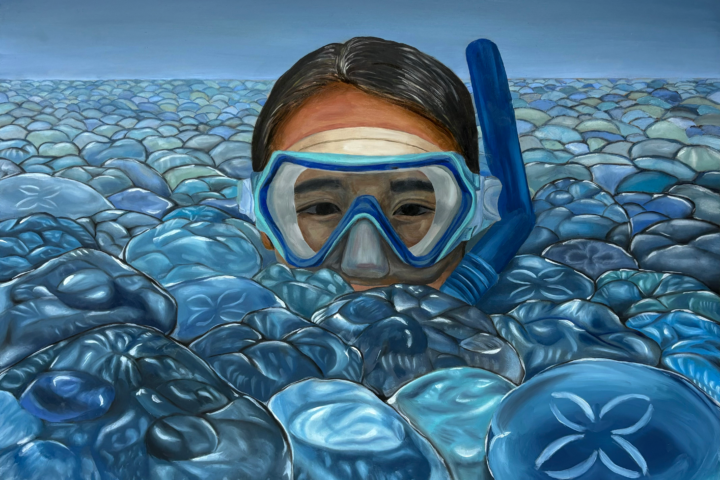
Cover image: The Tide of Jellyfish by Hyemin Lyoo, 2024
While space exploration often dominates the headlines, 2026 has been a landmark year for discoveries much closer to home. Marine biologists and deep-sea researchers have identified a series of new species that challenge our current understanding of life in the deep ocean. Exploring the “Midnight Zone” (a region of total darkness and immense pressure), expeditions have captured footage of organisms that look almost entirely alien to our world. From bioluminescent predators to translucent invertebrates, these newly cataloged species offer a rare look into the Earth’s least explored frontier.
One of the most interesting creatures that caught our eyes was during an expedition along the coast of Argentina. Researchers using a remotely operated vehicle recorded a rare giant phantom jellyfish at a depth of about 820 feet (which is about the size of the world’s largest and tallest Ferris wheel!). This species belongs to the scientific group Stygiomedusa gigantea and can grow up to 33 feet long. Its bell measures about three feet in width, and it has four long arms that it uses to catch prey. Unlike most other jellyfish, this species does not have stinging tentacles. Scientists from the Schmidt Ocean Institute and the University of Buenos Aires noted that this creature is rarely seen because it usually lives in the dark midnight zone of the ocean.
Researchers also explored the Salas y Gómez and Nazca ridges near the Chilean coast. This area contains over 200 underwater mountains that host unique biological communities. The team identified several species of deep-sea corals that live as individuals rather than in large reefs. They also found glass sponges, which have skeletons made of silica. These organisms filter nutrients from the water and provide habitats for small crustacean species. Scientists used high-definition cameras to map these seafloor features for the first time. The data shows that many of these animals are not found anywhere else on Earth. This information helps international organizations decide which parts of the ocean need legal protection from fishing and mining.
In addition to the findings in Argentina, a recent expedition in Australia has officially identified a new species of bioluminescent shark. Scientists named the animal the West Australian Lanternshark, or Etmopterus westraliensis. This discovery comes from research conducted by the CSIRO (Commonwealth Scientific and Industrial Research Organisation) using the vessel RV Investigator. The shark lives at depths of about 2,000 feet in total darkness.
The West Australian Lanternshark is quite small, with the largest individuals measuring only about 16 inches long. It has large eyes that help it see in the dim light of the deep ocean. The most notable feature of this species is its ability to produce light through specialized organs called photophores. These organs are located on its belly and along its sides.
Biologists believe this light serves several functions for the shark. By glowing on its underside, the shark can perform counterillumination. This process allows it to blend in with the faint light coming from the surface, making it nearly invisible to predators swimming below it. The light may also help the sharks communicate with each other or identify others of their own species in the dark.
Scientists also discovered a new species of carnivorous sponge in the Southern Ocean near the South Sandwich Islands. Named the “death-ball” sponge, or Chondrocladia sp. nov., this organism was found at a depth of 11,814 feet. Unlike typical sponges that filter water for food, this species has a spherical body covered in tiny hooks. These hooks allow the sponge to trap live prey like small crustaceans as they drift past in the current. Once an animal is caught, the sponge slowly surrounds it with a digestive membrane to absorb nutrients. This adaptation is essential for survival in the deep ocean, where food is often scarce.
The sudden increase in deep-sea discoveries this year is no coincidence. It is the findings of a global effort called Ocean Census, which aims to find 100,000 new marine species over the next decade. Using advanced remotely operated vehicles, researchers can now explore extreme habitats that were previously impossible to reach. These missions are critical because they help scientists understand how life adapts to extreme pressure and total darkness. Documenting these “masterpieces” of nature also provides the data necessary for international organizations to create new marine protected areas and preserve these fragile ecosystems for the future.