
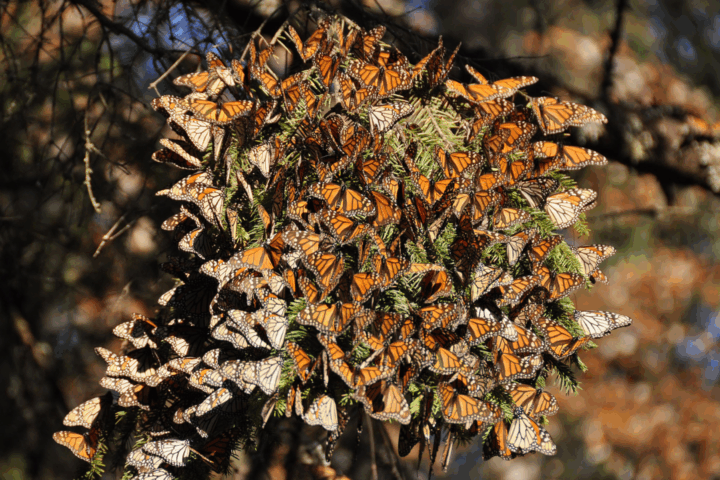
The Monarch Metamorphosis: Lend a Hand, Save a Wing
September 10, 2025By Cynthia Zhang, 2025 Future Blue Youth Council member & 2024 True Blue Fellow
Cover Photo by Prof. André Green, ECE University of Michigan
The living environment resembles a spider web, an intricate structure shaped by time, strong enough to withstand nature’s winds, yet fragile enough to collapse under one tug of a human hand. The story of the monarch butterfly is not so different—its metamorphosis, a delicate process of transformation from egg to adult butterfly perfected over 2 million years (Smith et al.), has been destroyed by humans within decades. Despite the monarch’s resourcefulness, resilience, and evolutionary advantages, they face a 56–99% chance of extinction by 2080, according to the U.S. Fish & Wildlife Service (U.S. Fish & Wildlife Service). Many people are concerned about the species dying out, fearing the disappearance of their iconic orange and black-veined wings, but perhaps more troubling is the potential loss of their metamorphosis, one unlike any other…
An Egg-cellent Start
The egg—one among 100 to 500 total eggs produced by the same female monarch butterfly—is first laid on a milkweed plant, the exclusive host plant of monarch butterflies. Milkweed is named for its toxic, milky sap, which monarchs have evolved to tolerate and consume as a defense mechanism against predators. However, the monarch caterpillar’s first meal is not the milkweed under its feet but its own nutritious eggshell, as it eats its way out of it and finishes the remains after emerging.
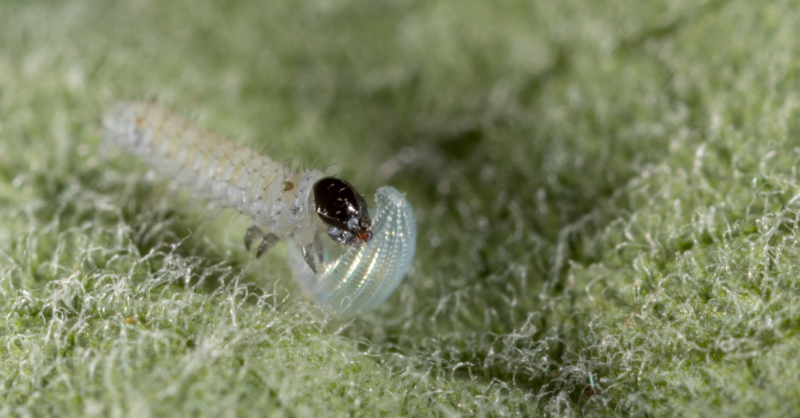 Photo: monarchjointventure.org – A newly hatched monarch caterpillar eating its eggshell
The Very Hungry Caterpillar
The newly hatched caterpillar, as narrow as a fingernail, is almost unnoticeable to the human eye—but not for long. After only one to two weeks of nonstop milkweed munching, the caterpillar increases to 2,000 times its original mass, exhibiting its white, yellow, and black bands. Over this time period, the caterpillar molts four times to make room for growth and, once again, consumes its skin to recycle essential nutrients.
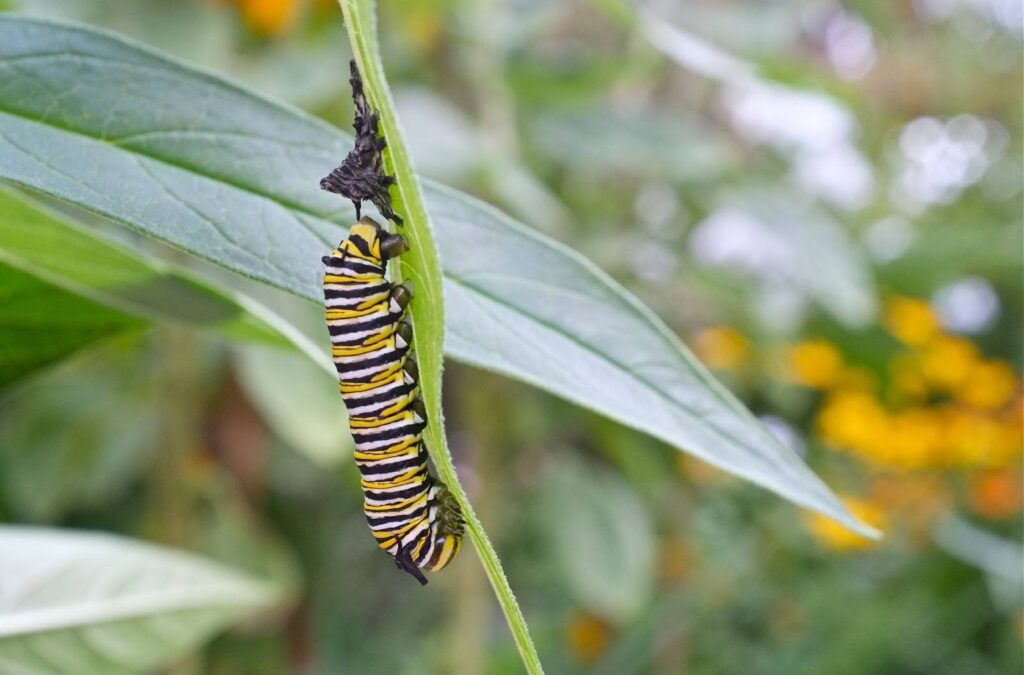 Photo: kimsmithdesigns.com – A newly molted monarch caterpillar
Chrysalis Concoction
At last, the larval stage comes to an end when the monarch caterpillar is around 1 inch long. Preparing for its final molt, the striped critter weaves a silk pad, hooks its fifth pair of prolegs onto it, and hangs upside down in a “J” shape. Within 24 hours, the skin splits at the head, revealing a light jade interior. The skin continues to rip upwards as the green chrysalis contracts vigorously. After five minutes of wiggling, all is still.
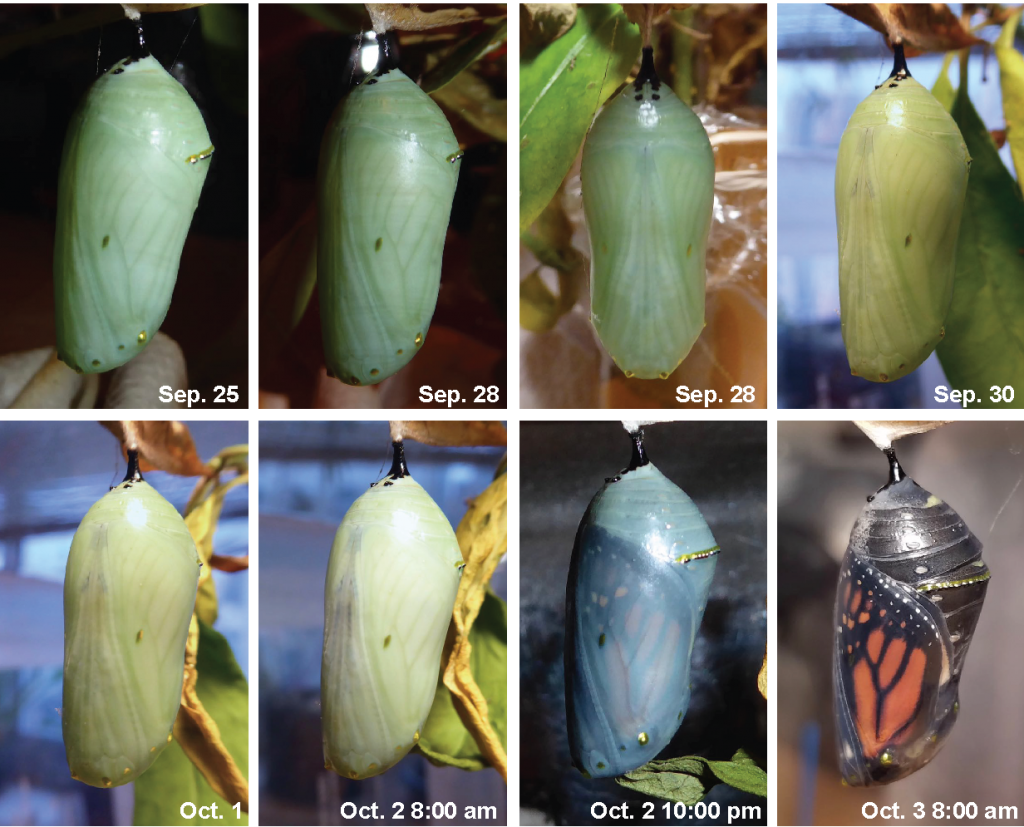 Photo: laguardiacornergarden.org – Monarch chrysalis progression
The Final Transformation
In the next 8 to 12 days, a concoction of hormonal changes and enzymes digests the insect’s insides, forming new muscles and organs. Onlookers catch a glimpse of this incredible transformation as the chrysalis gradually turns translucent, revealing the inner black and orange wings. Finally, the long-awaited moment comes: The clear casing splits open at the bottom of the chrysalis, and the monarch butterfly emerges, like a newborn, head first. Over a few hours, its soft, crumpled wings extend into its full splendor, ready to take its first flight into the world.
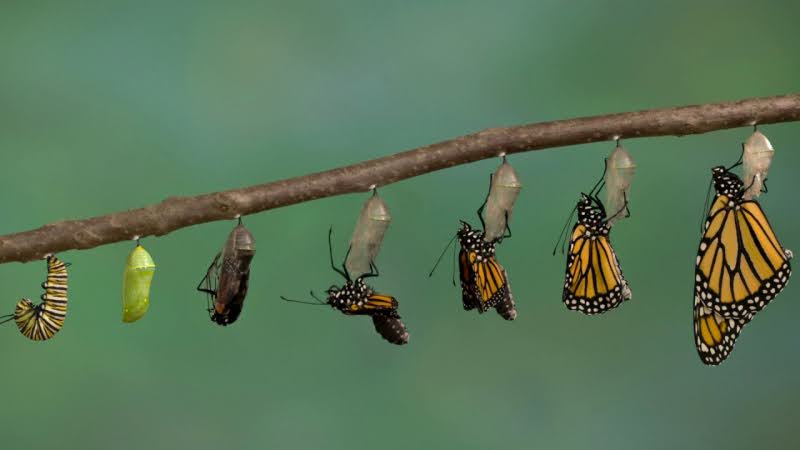 Photo: veritaspress.com – Monarch butterfly emerging from chrysalis
By this time, only 5% of eggs survive, but at normal rates, they make up hundreds of millions of butterflies. Today, that number has plummeted by 80–99% since the 1990s due to habitat loss, pesticide use, and deforestation caused by human activity (U.S. Fish & Wildlife Service). The future of the monarch butterfly—and its metamorphosis—rests in our hands.
Join the Monarch Mission
There’s still time to reverse this decline and help our kings and queens of the sky fly again. From 2024 to 2025 alone, the overwintering monarch population in Mexico has doubled from 2.22 hectares to 4.42 hectares of forest area occupied by hibernating colonies (World Wildlife Fund). We must continue to support our monarchs until they grow to at least 6.0 hectares, the population goal for safety from extinction established by Canada, the United States, and Mexico (Thogmartin et al.).
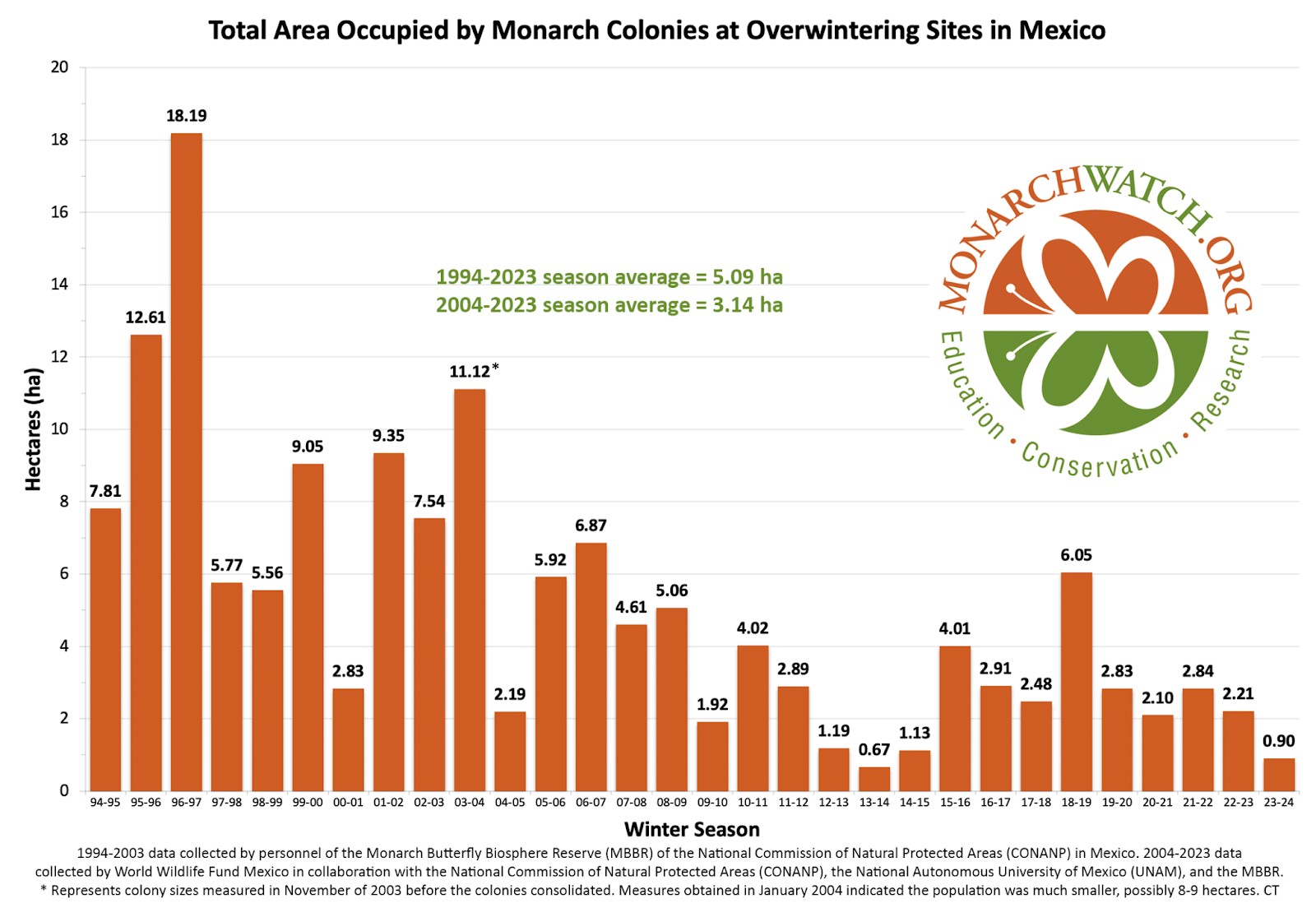 Graph: monarchwatch.org – Eastern monarch butterfly population decline from the 1994-95 to 2023-24 winter season
Here are actionable ways to help the monarch’s recovery. Even if you don’t live in North America along the monarch migratory path, you can still implement these methods to support native pollinators and promote local biodiversity in your country or community.
- Plant native milkweed, the only plant that monarch butterflies lay their eggs on and that monarch caterpillars eat as a food source. Choose the milkweed species native to your region, and start by picking up seedlings from your local nursery—locate one from Monarch Joint Venture’s Milkweed and Wildflower Vendor Map.
- Eliminate pesticide and herbicide use, two top causes of monarch mortality. Swap them for natural methods of pest control, like spreading cedar mulch and planting fragrant herbs.
- Grow nectar flowers to fuel migrating monarch butterflies on their 3,000-mile migration journey from Mexico to the United States and even parts of Canada!
- Contribute to community science projects for monarch conservation research, whether it’s tagging for the Monarch Watching Tagging Program, data collection for the Monarch Larva Monitoring Project, or sighting reports for Journey North. Find more community science opportunities here.
- Reduce your carbon footprint. Climate change is a major driver of the monarch’s decline and the global biodiversity crisis. Incorporate sustainable practices into your life, whether it’s reducing energy use or volunteering two hours a week with a local nonprofit—you know the drill.
- Spread the word, share this blog. Just like the thousands of monarchs migrating south this summer, this isn’t an individual effort, it’s a transnational movement!
 Photo: Cynthia Zhang, Monarchs Matter – Youth learning about the monarch butterfly metamorphosis and community science projects at the ReWild Dodge Garden and Monarch Waystation in Long Island, NY
Works Cited
Smith, David A. S., et al. “A Classification of Danaus Butterflies (Lepidoptera: Nymphalidae) Based upon Data from Morphology and DNA.” Zoological Journal of the Linnean Society, vol. 144, no. 2, June 2005, pp. 191–212, https://doi.org/10.1111/j.1096-3642.2005.00169.x. Oxford Academic.
Thogmartin, Wayne E., et al. “Evidence for a Growing Population of Eastern Migratory Monarch Butterflies Is Currently Insufficient.” Frontiers in Ecology and Evolution, vol. 8, Feb. 2020, https://doi.org/10.3389/fevo.2020.00043.
U.S. Fish & Wildlife Service. “Monarch Butterfly (Danaus Plexippus) Species Status Assessment Report, Version 2.3.” Regulations.gov, Dec. 2024, downloads.regulations.gov/FWS-R3-ES-2024-0137-0017/content.pdf.
World Wildlife Fund. “Eastern Monarch Butterfly Population Nearly Doubles in 2025.” World Wildlife Fund, 6 Mar. 2025, www.worldwildlife.org/stories/eastern-monarch-butterfly-population-nearly-doubles-in-2025.