
True Blue Fellowship Project Spotlight – FiberFusion: Painting with Plastics for Microplastic Awareness
December 30, 2025By Nafisa Marei and Stella Hong, 2025 Future Blue Youth Council members
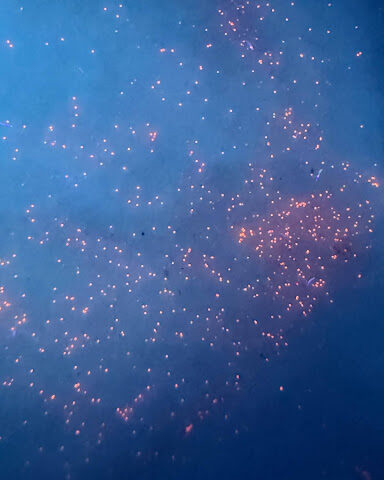
Featured image: microplastics fluorescing under UV light
Microplastics—plastic particles that are often too small to be seen with the unaided eye—are found in nearly every corner of the Earth – oceans, air, food, and even our bodies. Through her project FiberFusion, Jing Graber weaves art and science to turn microplastics into breathtaking paintings of marine life, illuminating the harsh reality of these pollutants.
Jing’s interest in microplastics began with her research at the University of Texas, studying the impact of microplastics on mosquitofish. She was surprised and disturbed to discover that microplastics were present nearly everywhere. Even remote volcanic islands and Arctic ice sheets are impacted by plastic pollution. Jing realized the prevalence of microplastics in daily life was easy to underestimate due to their minute size. While specialized equipment allowed researchers to view the particles, there was a lack of widespread methods for the public to visualize the impact of the particles. For Jing, art seemed like the obvious answer.
While art and science aren’t things that people tend to associate with each other, Jing Graber has been fascinated from an early age by the intersection of the two. As a scientist, she is passionate about protecting ocean biodiversity and conducts research to protect marine life from pollutants. As an artist, she is dedicated to translating scientific data into moving art pieces highlighting marine ecosystems.
“I just love how [art] can influence people around me. A lot of science is written, and a lot of it is written in a way that’s kind of inaccessible to the public. Visualizing science [through art]…can have this power to be memorable, transform how people think, and give a deeper level of connection than even writing for the public can,” Jing explains.
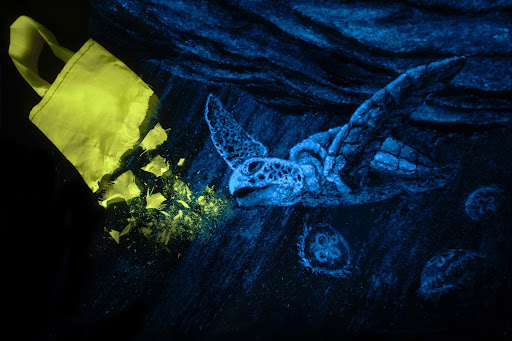
Inspired by sculptures made from reused plastic, Jing decided she wanted to tackle an art piece from a new lens; she wanted to paint directly with the microplastics. She began by developing a 3D-printed spindle that creates microfibers, a type of microplastic, from fluorescent plastics. This novel spindle device also makes it easier for researchers to work with and study microplastics. After creating the microfibers, Jing suspended these plastics in a clear paint, creating a translucent varnish speckled with plastics. After several months of trial and error, she finished her first painting—a breathtaking image of a sea turtle.
Sea turtles are one of the aquatic animals most heavily affected by microplastic pollution in the ocean (Curl et al.). Researchers believe that microplastic accumulation contributes to systemic inflammation and organ damage. Given that sea turtles are already facing severe population problems, it’s especially worrying that the highest concentrations of microplastics are found in male sea turtles’ reproductive organs (Hutchins).
Currently, Jing is working on developing other microplastic artworks, incorporating even newer methods such as the use of microspheres, glowing plastics, and more diverse fluorescent stains. Today, microplastics can be found almost everywhere in the environment, on our clothes, and even in our bodies. Through FiberFusion, Jing hopes that visually seeing microplastics in a painting can encourage people to be more aware of their environment and how plastic pollution surrounds them. Every small action, from avoiding single-use plastics to cleaning up your local stream, can help. While the danger of microplastics may seem insurmountable, innovative researchers like Jing are showing that by being aware of the issue and making small changes in our lives, we can have a big impact.
The project is supported by the True Blue Fellowship, a global program of Bow Seat: Creative Action for Conservation that supports youth-led environmental projects. Throughout the year, Future Blue Youth Council members Stella Hong and Nafisa Marei helped to support Jing with regular meetings, funding opportunities, and outreach opportunities. Stella and Nafisa were inspired by Jing’s innovation, creativity, and commitment to environmental advocacy, and they are excited to see how FiberFusion will continue to grow!
Sources
Curl, Lindsay F., et al. “Assessing microplastics contamination in unviable loggerhead sea turtle eggs.” NIH, 16 Dec. 2023, pubmed.ncbi.nlm.nih.gov/38104820/.
Hutchins, Rob. “‘Shocking’ levels of microplastics found in sea turtle organs.” Oceanographic, 4 Jan. 2025, oceanographicmagazine.com/news/shocking-levels-of-microplastics-found-in-sea-turtle-organs/.