
When Mangroves Cry
August 15, 2025By Rafael Bonilla Abad, 2025 Future Blue Youth Council member
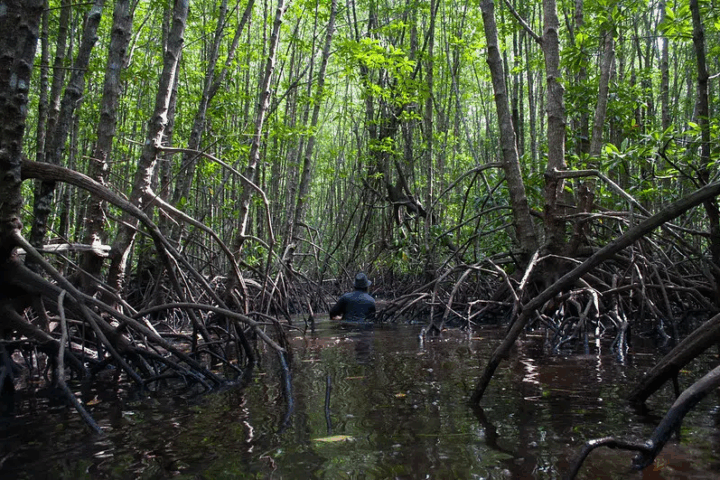
Cover photo by: Earth.org
Mangroves are one of the most interesting ecosystems on our planet. Although they only occupy a little land and are picky when it comes to where they live, their importance cannot be overstated. It’s fair to say that mangroves pull more than their weight. And yet, we are losing them. In Guayaquil, Ecuador, where I live, we removed roughly 173 acres of mangrove estuaries for urban expansion or shrimp farming between 1970-2010 (El Universo).
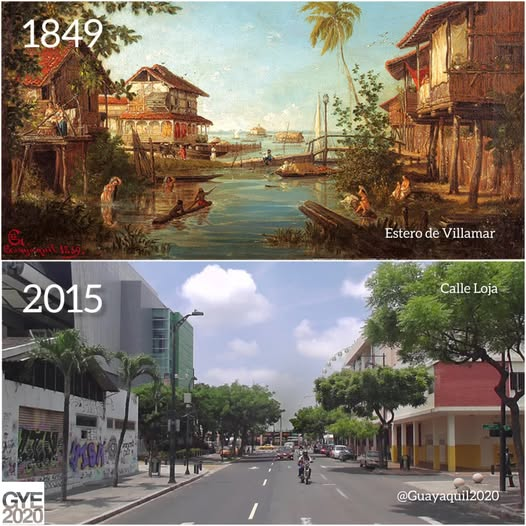 Credit: Guayaquil2020, Guayaquil, Ecuador 1894/2015
The idea to write something about mangroves came to me after passing through a neighbourhood that was built on a filled-in estuary – a graveyard for mangroves, if you will. The neighbourhood was beautiful and seemed like a peaceful refuge from the craziness beyond thanks to the trees. My parents told me they were mangroves, but they were actually giant rubber trees with thick aerial roots (hey, at least they tried).
There were few of them, and I found myself thinking, “how sad it must be to be alone in a world so cold”. That question stayed with me, and I wrote something to answer it. So let me tell you a story about a dying world (dystopian, I know). It’s called:
When the Mangrove Trees Walk
I wake up to the creaking of walking Mangrove trees again, a thin layer of sweat covering my forehead. Third one this week. Most people don’t mind the crackle, but then again, they’ve grown deaf to their cries. Still groggy, I look out my window and see the Mangrove tree limping in the dark street. A healthy tree should walk spider-like on its stilt roots, but this one drags them along in search of its estuary. But the estuaries have long been filled with cement, and most of the Mangrove trees have died or given up.
The tree needs help, so I put my shoes on. It reminds me of the first time I watched a Mangrove die, back when the world was healthier. Before the nights were hot and rain was scarce.
***
I was visiting my grandparents. Their house was built on a filled-in estuary branch. It was one of those lonely afternoons after the family dog died and my cousins moved to the highlands, before I took on sleeping as a way of disappearing. I sat on the small lawn, playing with the grass and watching the occasional car pass.
A sound like sweeping dry leaves grew steadily for a while before I saw it—a graying Mangrove tree whose leaves had turned brown. It stopped in front of me in the middle of the street.
I rushed inside and brought out all the buckets and containers full of water I could. I set them down and helped the Mangrove put the ends of its roots in the water. I didn’t understand death, yet. All I knew was that it looked sad.
It creaked with relief and splashed water on its bark until it was tired. For a moment, it seemed like it was getting better. It held my hand with a wet root; the bark was rough, but it was careful not to hurt me. The Mangrove plucked its greenest leaf and gave it to me with a trembling root. After staring at it for a moment, I took it. The Mangrove dragged its root back to the bucket and dripped water on its body, but the brown of its bark kept fading to gray. The Mangrove crackled, shook, and swayed. It started to fall on me and I screamed for help, but it caught itself with a root and pushed itself sideways. It would have crushed me if it hadn’t.
My parents found me crying with the ash colored tree at my feet. Later that day, my dad helped me press and frame the leaf. I hung it in my room and never took it down.
***
The Mangrove tree is shaking, and its bark has the dullness of death. I don’t know why they’re coming so far away from the estuary. I take off my shoes. I close the window, but the sound of the crash isn’t dampened. It did its best not to damage anything. Mangrove trees are kind to us; I don’t know why. At least this one didn’t die in the sun.
There aren’t many Mangrove trees anymore. They aren’t unheard of but—
We killed them. We butchered them for their wood and claimed their space for houses and shrimp farms. Soon they’ll be gone. Then we’ll want to harvest Ceibos1 trees’ silk-cotton seeds and take their land too. But the Ceibos trees are a proud and tall race with thorns on their green trunks, and they will not be as kind to us as the Mangroves.
They will not go gentle into that good night’s sleep.
The narrator’s perspective is bleak, but I urge you not to see things the same way. Instead, let’s focus on learning.
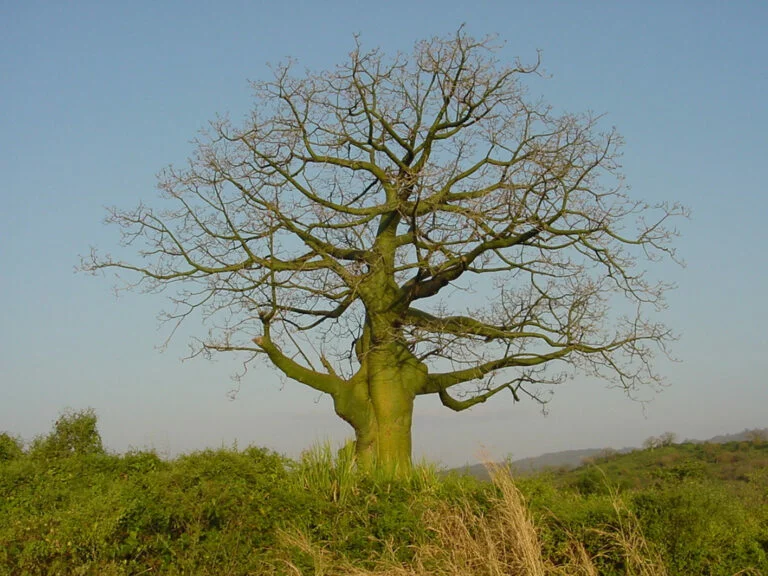 This is a ceibo tree in case there are any curious cats reading. Credit: El Diario
Mangroves are wonderful and fascinating ecosystems2. The first thing that comes to mind is their bonkers adaptations. Most notably, stilt roots that make them look like daddy-longlegs also help filter out copious amounts of salt and stand upright in mushy mud like British guards; fashionable and functional. Where most plants would shrivel up and ask for mercy, the mangrove bows to no one.
On top of that, mangroves store 10 times as much carbon as terrestrial forests, protect coasts from rising sea levels and storm surges, shelter ~1500 species, and around 80% of the world’s fishing depends on them in some way (OneTreePlanted). Their canopies are a tranquil refuge for all those lucky enough to live near them, animal and human alike.
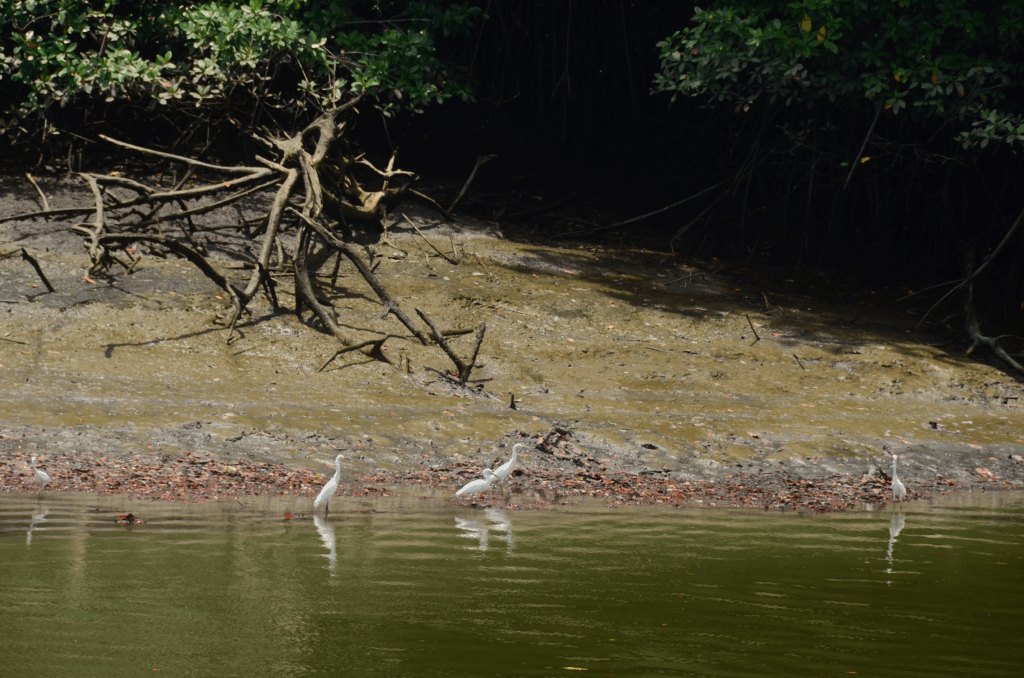 Credit: Rafael Bonilla Abad. Puerto Hondo, Guayas, Ecuador, 2025
In short, they’re great, but what happens when we lose them?
Mangroves are coveted because their wood is hard and resistant to humidity. The space they occupy is also desired for aquaculture (legal and illegal) or for building neighbourhoods that sink. These practices are harmful to the mangroves, the species they harbor, and the people who rely on them. In Ecuador, there are nearly 8 thousand families that economically rely on mangroves and many more that emotionally depend on them, as we take our crab dishes very seriously3 (The Coalition for Human Rights in Development).
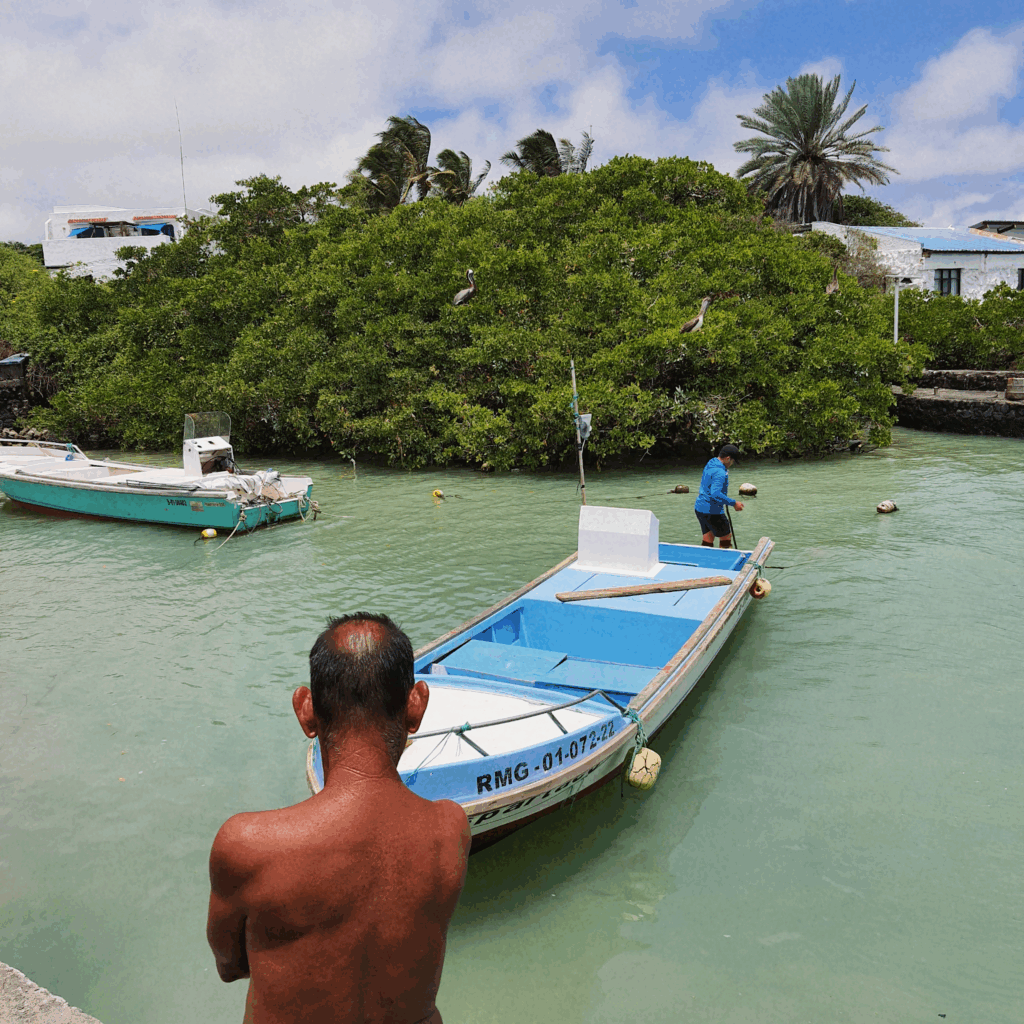 Credit: Rafael Bonilla Abad. Santa Cruz, Galápagos, Ecuador 2023
Once mangroves disappear, recovering them is very difficult because the conditions for them to thrive are no longer right (Conservation International). This means changes to mangroves can irreversibly endanger the livelihoods of communities that depend on them for food, income, and culture.
The situation is scary, but I’m not alone in addressing it. Previous participants in Bow Seat’s Ocean Awareness Contest have had mangroves at the center of their work. This beautiful poem by Sagar Gupta and moving video by Krish Dua are great examples of this.
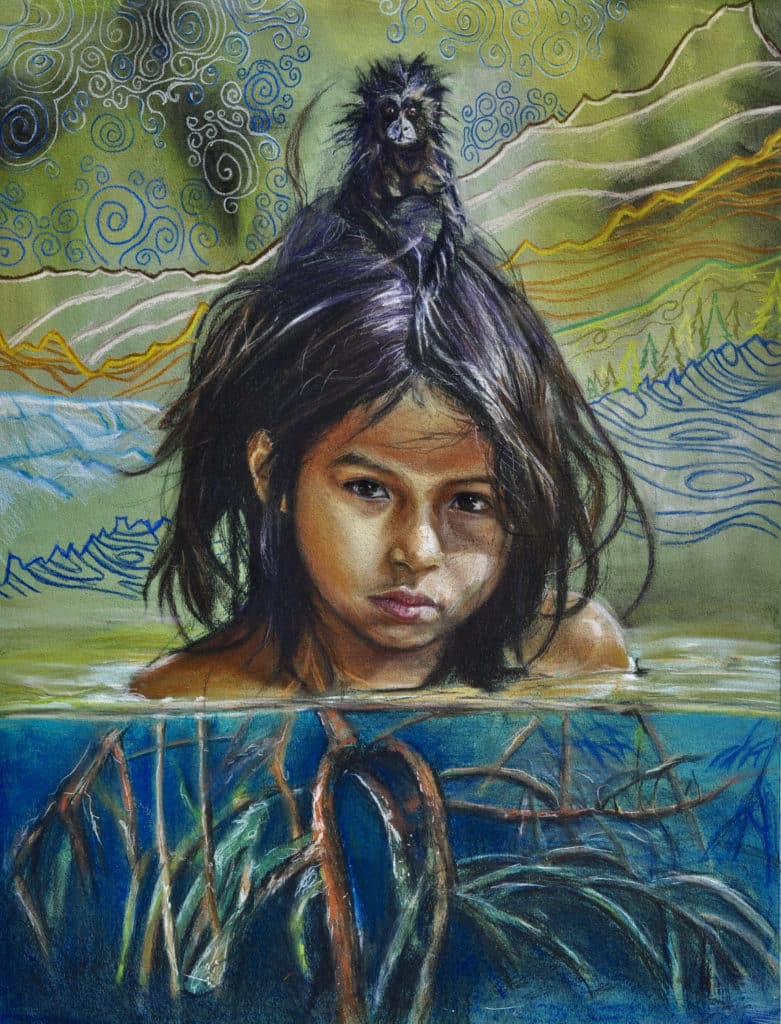 “Dying Roots”. Credit: Daniel Nam, 2022
Luckily, not all hope is lost. Projects like Socio Manglar, Heifer Ecuador, and the Forest Investment Program aim to reduce the impact of human activities on mangroves; the first two include the protection of mangrove communities at the core of their plan. In Ecuador, some protected areas have increased mangrove coverage thanks to government initiatives that reduce illegal aquaculture and require aquaculture companies to adopt reforestation plans (The Coalition for Human Rights in Development).
Lawmakers have the ability to save mangroves, but simple logic and morals are famously hard for them to grasp (note that I said “hard”, not “impossible”). It’s easy to feel powerless, but working at Bow Seat, I’ve learned firsthand that art can help make change; Bimochan Pathak’s project Paribartan Ko Lagi Kala is a great example of this. Creative works impact us in a visceral way that academics often can’t. Proof: It’s entirely possible that after you’ve forgotten every word I wrote, the images I chose still stay with you (rude, but okay). So, aside from dealing with the usual suspects of climate advocacy, remember there’s power in numbers. By creating art, we are putting the numbers in our favor. That’s what we should strive for.
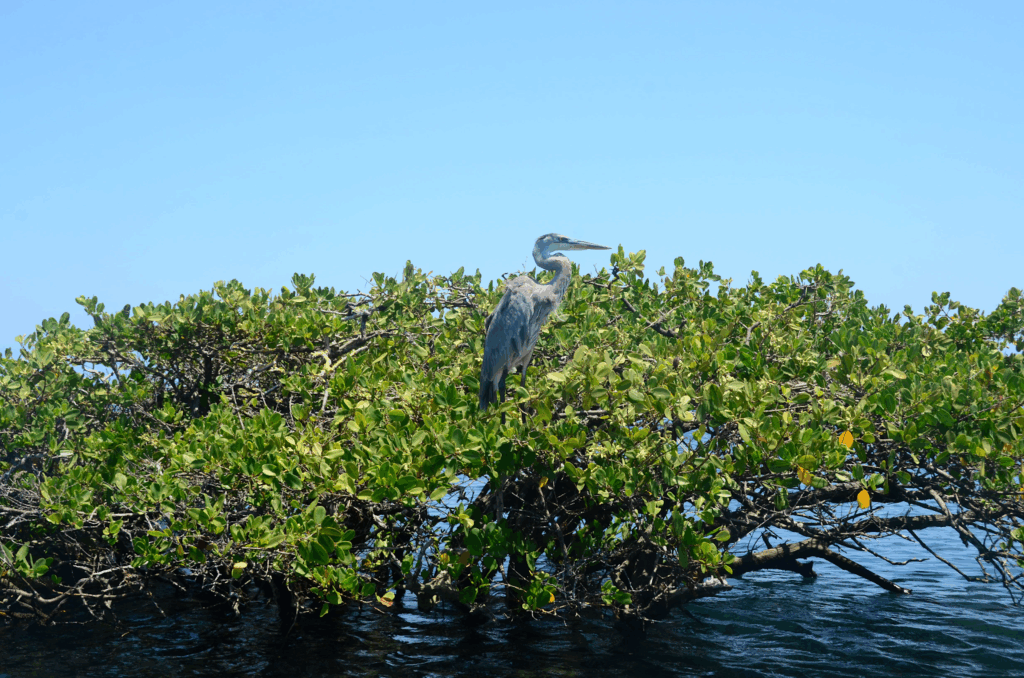 Credit: Rafael Bonilla Armijos. Santa Cruz, Galápagos, Ecuador 2018
1 Ceiba trees are native to northern South America.
2 “Mangrove” can refer to both the tree and the ecosystem. I agree: not confusing at all.
3 One report literally measured the loss of mangroves with the unit “crab-man/day” or: how many crabs workers could catch in a day.
References
Conservation International. (n.d.). Mangroves: 11 facts you need to know. Conservation.org. Retrieved July 29, 2025, from https://www.conservation.org/stories/mangroves-facts
El Universo. (2009, July 12). Estero Salado muere al son migratorio [Estero Salado dies to the sound of migration]. El Universo. https://www.eluniverso.com/2009/07/12/1/1445/estero-salado-muere-son-migratorio.html/
Guayaquil. (n.d.). Guayaquil 1849 vs 2015. Facebook.com. Retrieved July 29, 2025, from https://www.facebook.com/Guayaquil2020/posts/antiguo-estero-de-villamar-actual-calle-loja-foto-1-%C3%B3leo-de-ernest-cart%C3%B3n-1845-f/885026193183286/
Marín, Y. (2025, April 20). Conozca siete curiosidades sobre el ceibo, el árbol emblemático de Manabí [Learn seven interesting facts about the ceibo, the emblematic tree of Manabí]. El Diario; Medios Ediasa. https://www.eldiario.ec/conozca-siete-curiosidades-sobre-el-ceibo-el-arbol-emblematico-de-manabi-20250420/
One Tree Planted. (2024, June 25). 10 interesting facts about mangroves. One Tree Planted. https://onetreeplanted.org/blogs/stories/facts-about-mangroves?srsltid=AfmBOorXrLxGzUbMW_SCrd5X0d4p9kPxIMBM0PukI2-1ekgYhW1rJFlR
The Coalition for Human Rights in Development. (n.d.). ECUADOR: MANGLARES GESTIONADOS A TRAVÉS DE CONCESIONES COMUNITARIAS [ECUADOR: MANGROVES MANAGED THROUGH COMMUNITY CONCESSIONS]. Rightsindevelopment.org. Retrieved July 29, 2025, from https://ewsdata.rightsindevelopment.org/files/documents/70/IADB-EC-T1370.pdf