Current Fellows
Meet our 2025 True Blue Fellows!
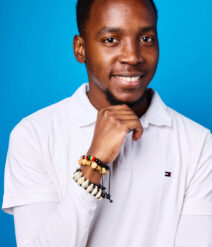
23 | Tanzania | Heroes of the Indian Ocean
This project aims to document and tell the story of Tanzania’s marine ecosystem in the Indian Ocean, focusing on how coastal communities depend on it for fishing, seaweed farming, and tourism. It highlights the destruction of coral reefs due to climate change and human activities, and showcases efforts by youth-led and non-profit organizations advocating for policy changes and coral reef restoration.The story will be conveyed through an immersive 360° video experience, observed via Virtual Reality (VR) headsets and enhanced with Augmented Reality (AR), to inspire policymakers and engage youth in protecting and restoring the marine ecosystem.
The project also underscores sustainable practices in fishing, seaweed farming, and eco-friendly tourism.Using VR and AR, it not only educates but emotionally connects viewers to Tanzania’s marine challenges. This innovative approach seeks to inspire action, drive policy reform, and empower communities to protect the marine ecosystem sustainably.
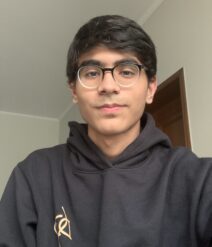
16 | Pakistan | Create for Our Lives
We seek to use the transformative power of the creative arts to spark curiosity about the environment in the minds of the next generation. During the course of our project, we would visit an underfunded school populated by working class youth to conduct monthly generative art and writing workshops centered around existential threats posed by climate change in Pakistan, preserving national waterways, and hopeful imagined futures. The first phase would build up the children’s confidence in their written and/or artistic expression, as well as their knowledge about climate change. The second phase would involve discussing and formulating ideas for students’ personal/group projects, which would be tethered in some way to the future: art projects, displays with written components, speculative fiction, etc. The last phase would involve setting up a small exhibition of these projects, coupled with a prize ceremony in the categories of art and writing. The journey would be documented by our team.
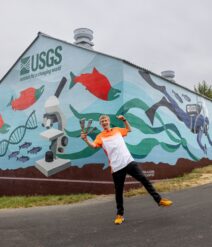
19 | United States | Save Our Salmon (SOS) Mural Series
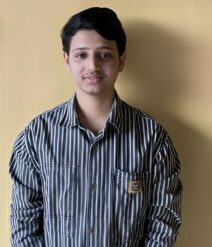
17 | Nepal | “Paribartan Ko Lagi Kala” (Art for Change)
Rural Nepal has an invisible issue. While the urban areas have local governments execute waste collection and disposal systems, although they have their own flaws, most rural districts lack any waste management system at all, especially plastic waste which makes its way to waterways and soil affecting nature and public health. Multiple research works done on microplastics in the past five years have provided evidence of the occurrence of microplastics in Nepal’s diverse aquatic ecosystems. Although the environmental issue is a pressing issue globally, rural areas in Nepal face a significant gap in education and awareness about this issue which is why people think it’s okay to dispose of plastic waste in rivers or bury it in the soil. My project “Paribartan Ko Lagi Kala” (Art for Change) aims to tackle this issue in Ward 8 or Shivapuri Rural Municipality in Nuwakot district in Nepal by reviving traditional crafts and reducing plastic waste through community engagement and education.
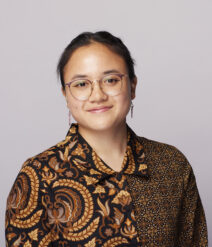
20 | Indonesia | Diverseas
Diverseas is an open-source asset for tech-enabled ocean literacy. We are building a network of ocean learners turned advocates through in-person workshops, 360° VR stories, and online resources. Diverseas connects young minds to those at the frontlines of ocean conservation. With the rise in ocean-career opportunities that have not been represented in mainstream education; younger generations often fail to recognise the plethora of possibilities that the ocean provides. At its core lies the lack of representation in these spaces. In other words, significant strides must be made to improve ocean literacy, make it more accessible, and authentically portray the many opportunities that lie ahead, particularly for the younger generations. By providing immersive learning experiences using 360° virtual reality (VR) videos, we hope to bridge the disconnect between communities and experts.
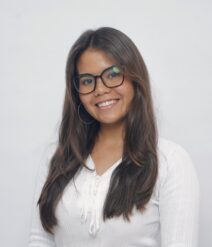
20 | Indonesia | DiveHer
DiveHer serves multiple communities, primarily focusing on Indonesian women and the broader marine conservation community. The project engages these communities through cultural storytelling by highlighting the personal and collective journeys of women participating in the Coral Catch program. I would continue to grow this platform to branch outside of the women in the coral catch program.
By documenting the experiences of these women, the project aims to inspire and empower other women in Indonesia and around the world to pursue careers in marine conservation and other traditionally male-dominated fields. The project DiveHer fosters a sense of community among female divers and conservationists, creating a supportive network that encourages collaboration and mutual support. Moreover, the project raises awareness about the importance of marine conservation and the critical role women play in this field.
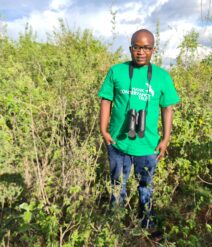
23 | Kenya | Embracing Maasai Culture to Safeguard Our Environment
Our project, Embracing Maasai Culture to Safeguard Our Environment, aims to leverage the rich cultural heritage of the Maasai community to raise awareness and inspire action on environmental issues, specifically targeting oceans, waterways, and climate change. By integrating traditional Maasai arts—such as beadwork, music, dance, and storytelling—we will create compelling narratives that educate and engage the community. Activities will include workshops, art creation, performances, community clean-ups, and conservation initiatives. These efforts will foster a deep sense of environmental stewardship, promote sustainable practices, and achieve tangible improvements in our local environment. This project is new and seeks to harness the power of creative arts to drive meaningful change within the Maasai community.
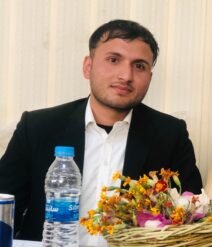
24 | Afghanistan | Voice of the Kunar River: A Creative Journey through Climate Change
This project uses visual arts, photography, and poetry to document and raise awareness about the impact of climate change on the Kunar River. By capturing the river’s changes through photography and creating poetry that reflects the community’s connection to this vital waterway, we aim to highlight the urgent need for climate action.
Public art installations and poetry readings along the riverbank will engage the local community, fostering a deeper understanding of how climate change affects their environment. Workshops will empower local youth to express their concerns creatively, promoting environmental advocacy through the arts.
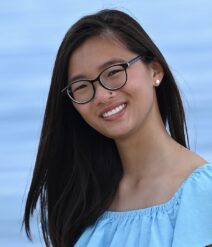
19 | United States | FiberFusion: Merging Art and Scientific Innovation
I hope to develop a microfiber-winding device which is 3D printable and automated. This device aids in the paraffin microtomy process and can be reproduced by researchers. The design is modeled after the contraption described in a novel methods paper (https://pubmed.ncbi.nlm.nih.gov/34551145/) I also hope to patent this device for credibility and create a 3D model using Blender software. When I first made this device without a 3D printer, it took over 60 hours of planning and sawing, but with this, researchers can save time and money.
In the art component of this creative project, I will draw an ocean animal. Then, I will produce microfibers with my spindle and use a lipophilic stain to make them glow red under UV light. I will suspend the fibers in clear paint and paint images of pollution onto a glass pane. I will put the glass over my drawing. When the lights turn off and UV lights turn on, the painting will glow red, revealing the plastic pollution painting.
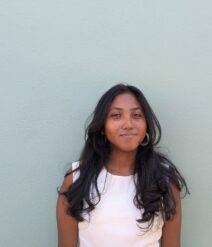
22 | Madagascar | Blue Days at Schools
Blue Days at Schools is an initiative dedicated to educating students in Madagascar about the nation’s rich marine biodiversity, which is often overlooked in favor of its terrestrial environments. This project aims to introduce students to Madagascar’s blue heritage through interactive workshops and a compelling video that showcases key marine ecosystems and their connection to climate change. The project seeks to instill a sense of environmental stewardship among young people and encourage the broader community to recognize the importance of marine conservation. We will produce an engaging video that highlights Madagascar’s most significant blue heritage. This video will serve as both an educational tool and an inspirational piece, designed to captivate and inform students about the rich marine biodiversity surrounding their island.
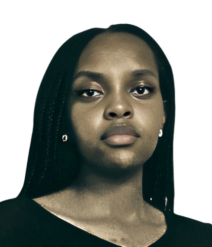
22 | Kenya | Mashujaa Wa Bahari (Ocean Heroes in Swahili)
I plan to curate and build Kenya’s first online gallery of illustrated Marine life: This gallery will serve as a compendium/database of Indian Ocean Marine Life, promoting appreciation and awareness of the Indian Ocean Ecosystem through scientific illustration, or “Using Art for Science.” The works will also be used as educational materials for coastal communities and the Kenyan audience at large.
I also hope to hold physical workshops for scientific illustration: These workshops will engage, educate, and empower artists in the Coast and beyond to use their art to promote marine conservation and bridge the gap between art and science in Kenya.
16 | United States | “Stella & the Starlight Solution,” & Other Environmental Children’s Books
With our project, we plan on creating a series of children’s books centered around environmental themes. The first book is aimed at addressing eco-anxiety among young children. Eco-anxiety is becoming more and more common as time progresses, and the issue is not given nearly enough attention because it’s often dismissed as irrelevant or unimportant. It’s also difficult for those struggling with eco-anxiety to seek out therapy or other treatment because therapy is quite cost-prohibitive. By focusing on addressing eco-anxiety and anxious thoughts about the environment with a children’s book, we aim to help children who are struggling to cope with the realities of climate change in a way that’s easily accessible, free of the stigma of traditional therapy treatments, and inexpensive. The second element of our project is a photography and soundbites contest. The sounds and scenes of nature are incredibly beautiful, and we hope entrants will be more mindful of their natural surroundings.